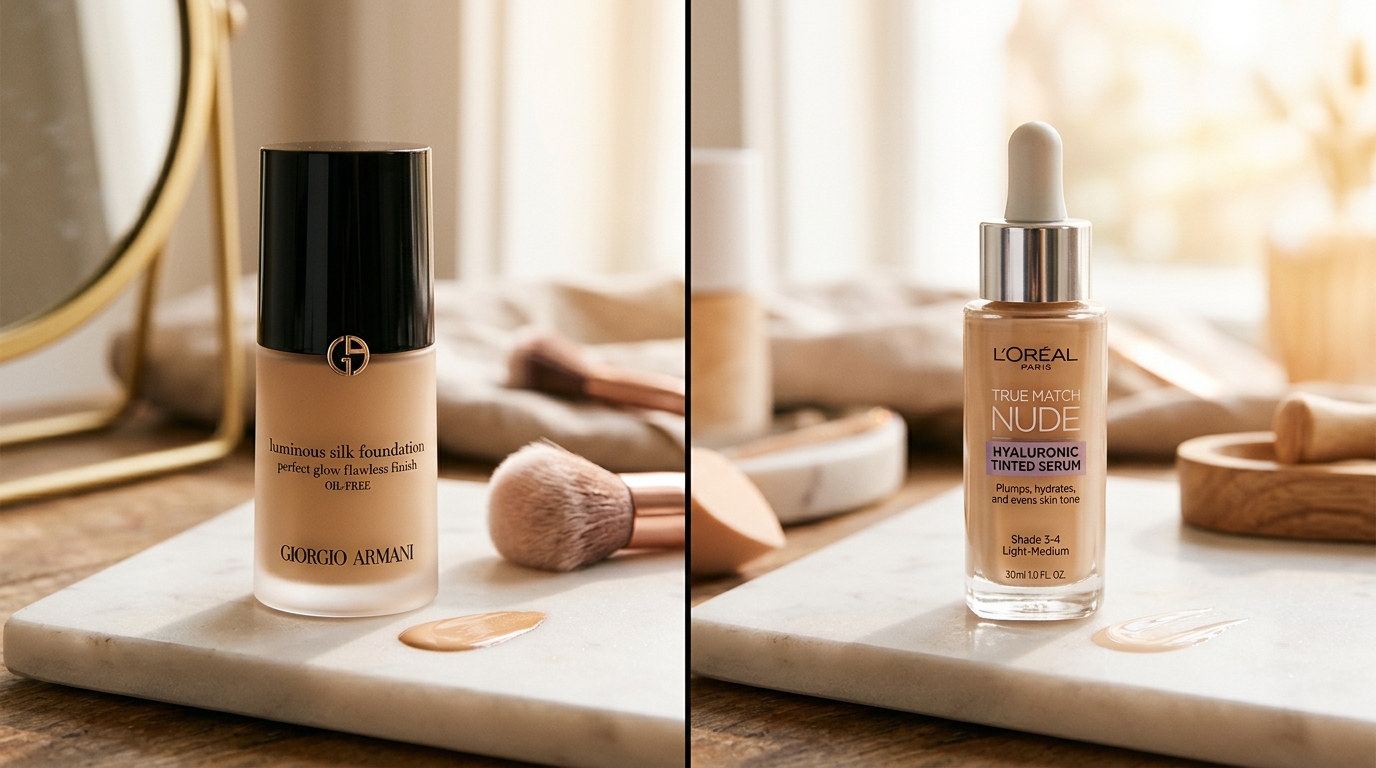
It is the most-repeated claim in the beauty community: L'Oréal True Match Nude Hyaluronic Tinted Serum is a dupe for Armani Luminous Silk. Reddit threads have called it a near-perfect match. TikTok creators have done side-by-side swatches. Beauty editors have written entire articles about it. But does the claim actually hold up on dry skin?
At $15 versus $69, that is a $54 difference per bottle — enough to matter. And on dry skin specifically, the two foundations are doing very different things underneath the pigment. This is the closest I have come to a genuine dupe in testing, but it is not a perfect match.
After a four-week blind comparison on dry skin, the honest answer is: yes, L'Oréal True Match Nude is a genuine dupe for Armani Luminous Silk at roughly 80–85% of the performance. The two look almost identical on the skin, feel almost identical to wear, and perform almost identically over dry patches. Armani wins on shade range and wear time; L'Oréal wins on price by a wide margin.
This is the full breakdown — ingredients, finish, coverage, wear, shade range, and the results of a blind test, round by round.
Is it a dupe? Yes — the closest we have found for dry skin. Where Armani wins: shade range (44 vs 14), wear time (8–10 hrs vs 6–8 hrs), and slightly more refined texture. Where L'Oréal wins: price (~$15 vs $69) and easy repurchase. Overall verdict: L'Oréal delivers roughly 80–85% of Armani's performance for ~22% of the price.
Key Takeaway
The L'Oréal True Match Nude Serum is a genuine dupe for Armani Luminous Silk on dry skin — with one critical exception: shade range. If you match into the L'Oréal's 14 shades, the two are nearly interchangeable in daily use. If you don't, Armani's 44 shades are worth the price difference.
The Two Foundations at a Glance
Before the deep-dive comparison, here is the short summary of what each product is and who it suits best.
Armani Luminous Silk Foundation
Finish: Natural, luminous
Coverage: Medium, buildable
Shades: 44
Wear: 8–10 hours
Key ingredients: Glycerin, niacinamide
The benchmark for luminous liquid foundations. Silky texture, flexible finish, and a wide shade range that has made it a favourite among makeup artists for over a decade.
L'Oréal True Match Nude Hyaluronic Tinted Serum
Finish: Dewy
Coverage: Sheer
Shades: 14
Wear: 6–8 hours
Key ingredients: 1% hyaluronic acid
The most-recommended drugstore dupe for Armani Luminous Silk. Serum-like texture, high hyaluronic acid content, and a dewy finish that looks like bare skin with a filter.
Side-by-Side Comparison Table
Here is the full spec comparison. The winning column in each row is highlighted.
| Feature | Armani Luminous Silk | L'Oréal True Match Nude | Winner |
|---|---|---|---|
| Price | $69 | ~$15 | L'Oréal |
| Shades | 44 | 14 | Armani |
| Finish | Natural, luminous | Dewy | Tie |
| Coverage | Medium, buildable | Sheer | Armani |
| Wear Time (Dry Skin) | 8–10 hrs | 6–8 hrs | Armani |
| Hydration on Dry Skin | Tie | Very high | Tie |
| Patchiness | Very low | Very low | Tie |
| Application ease | Easy | Very easy (serum-like) | L'Oréal |
| Texture refinement | More refined | Slightly less refined | Armani |
| Packaging | Glass bottle with pump | Glass bottle with dropper | Armani |
| Availability | Sephora, Ulta, department stores | Most drugstores, Target, Walmart | L'Oréal |
| Value for money | Good | Excellent | L'Oréal |
Ingredient Comparison
The two foundations share more ingredient overlap than their price difference suggests. Both contain glycerin and hyaluronic acid — the two most important hydrating ingredients in foundation formulation.
| Ingredient Category | Armani Luminous Silk | L'Oréal True Match Nude |
|---|---|---|
| Humectants | Glycerin, hyaluronic acid | 1% hyaluronic acid, glycerin |
| Barrier-supporting | Niacinamide (2026 reformulation) | Minimal |
| Emollients | Dimethicone, various esters | Dimethicone |
| Alcohol content | None in top ingredients | None in top ingredients |
| Fragrance | Light | Minimal |
| Overall formulation complexity | Higher — more ingredients, more refined feel | Lower — simpler formulation |
The honest read: Armani has a more complex formula, but the ingredients doing the heavy lifting for dry skin — glycerin and hyaluronic acid — are present in both. This is why they perform so similarly on dry skin despite the price difference.
The Blind Test: 8 Rounds
For four weeks, I wore each foundation on alternating days without looking at the label. Both were decanted into identical unmarked bottles. I applied them using the same routine every time — hydrating skincare, hydrating primer, damp sponge — and evaluated eight criteria without knowing which was which.
Here is how each round played out.
Finish and immediate look
Both foundations delivered a luminous, natural finish. Armani looked slightly more polished — the finish was marginally more refined, with a subtle blurring effect around the pores. L'Oréal looked slightly more dewy and "bare" — closer to what my skin looks like without foundation, but better.
In a side-by-side mirror comparison, I could tell them apart. But in the blind test — wearing one foundation one day and the other the next — I genuinely could not tell which was which.
Coverage
Armani is a medium, buildable coverage foundation. One layer evens tone; a second layer covers redness and blemishes with minimal effort. It can be built to a genuinely full coverage look if needed.
L'Oréal is sheer. One layer evens tone slightly and adds a hydrating glow. Two layers add a bit more coverage, but it never reaches the medium buildable level of Armani. If you need coverage for redness or blemishes, you will need concealer with L'Oréal.
Hydration and comfort
Both foundations kept dry skin comfortable at the four-hour mark. Neither felt tight or drying, and neither had started to catch on any dry patches. L'Oréal actually felt slightly more hydrating at hour 4 — the hyaluronic acid seems to have a small edge for maintaining moisture in the skin.
Armani felt slightly more "set" — as if the foundation had locked into place without losing hydration. This is a texture difference, not a hydration difference.
Patchiness and dry patch behaviour
This is where both foundations performed impressively. Neither caught on dry patches at hour 6. Neither looked patchy or separated. On the driest areas of my skin — the cheeks and around the nose — both foundations remained smooth and even.
At hour 8, L'Oréal began to show a tiny amount of wear on the driest patch of my left cheek — not patchiness exactly, but a slight thinning of coverage. Armani showed no wear at hour 8 and only minimal fading at hour 10.
Fine lines and settling
Both foundations behaved well around fine lines. Neither settled into the smile lines around my mouth or the fine lines under my eyes, as long as I applied them in thin layers and did not powder.
Armani had a slight edge here — its more refined texture seemed to "blur" into fine lines rather than sitting over them. L'Oréal was almost as good, but the sheerer formula showed fine lines slightly more.
Wear time
This is the biggest practical difference between the two. Armani lasted 8–10 hours on my dry skin with minimal fading. L'Oréal lasted 6–8 hours, with visible thinning starting around hour 6 and more noticeable at hour 8.
Both are still presentable at hour 6 — you would not look unkempt with either. But if you want a foundation that goes from morning to evening without touch-ups, Armani is the better choice.
Shade range and match
Armani offers 44 shades across fair to deep with a wide range of undertones. L'Oréal offers 14 shades with a limited deep range. If you fall into the L'Oréal's limited shade range and the undertone matches, you are lucky — the two look nearly identical in colour.
If you have a deep or very deep skin tone, or a specific undertone that L'Oréal does not offer, Armani is the only option between the two. This is the most important single difference for many buyers.
Application and ease of use
L'Oréal applies more like a serum than a foundation. It is easier to spread, easier to build, and easier to fix mid-day. The dropper dispenser also makes it easier to control how much product you use — you can dispense exactly what you need.
Armani requires a little more technique. The pump dispenses more product per press, so you need to be more careful about quantity. It also requires slightly more blending to look seamless.
Final Scorecard
| Round | Winner | Margin |
|---|---|---|
| 1. Finish and immediate look | Tie | — |
| 2. Coverage | Armani | Clear |
| 3. Hydration and comfort | Tie | — |
| 4. Patchiness on dry skin | Armani | Slight |
| 5. Fine lines | Armani | Slight |
| 6. Wear time | Armani | Clear |
| 7. Shade range | Armani | Decisive |
| 8. Application ease | L'Oréal | Clear |
Final tally: Armani wins 5 rounds, L'Oréal wins 1, and 2 are ties. But the margins matter more than the count. Armani's biggest wins are on shade range and wear time — two things that may or may not matter for your specific situation. L'Oréal's win on price (not tested in a blind round, but objectively decisive) is worth more than any individual round.
The Real Verdict: Is It Actually a Dupe?
Yes — but with important caveats.
Where L'Oréal is a genuine dupe: If you match into the L'Oréal's 14 shades, wear makeup for 6–8 hours a day, and want hydration and natural finish over coverage — L'Oréal delivers nearly everything Armani does at one-fifth the price. On dry skin, the two are almost indistinguishable in daily use.
Where L'Oréal is not a dupe: If you have a deep or very deep skin tone, need more than sheer coverage, or want a foundation that lasts 10+ hours — L'Oréal cannot fully replace Armani. These are genuine limitations, not just "differences."
The practical recommendation: Buy the L'Oréal first. Try it for a month. If it works for you, you have saved $54 on every bottle you buy going forward. If it doesn't, you have lost only $15 — and you can buy the Armani knowing exactly why you are paying more for it.
Who Should Buy Which
| If You... | Buy This | Why |
|---|---|---|
| Match into L'Oréal's 14 shades | L'Oréal True Match Nude | Nearly identical experience at 1/5 the price |
| Have a deep or very deep skin tone | Armani Luminous Silk | 44 shades vs 14 — Armani is the only one with your match |
| Want sheer, natural coverage | L'Oréal True Match Nude | The sheer, dewy finish is ideal for this look |
| Want medium or full coverage | Armani Luminous Silk | Buildable medium-to-full coverage |
| Need 10+ hours of wear | Armani Luminous Silk | Wears 2–4 hours longer |
| Work a standard 8-hour day | Either — your call | Both last comfortably through a workday |
| Have fine lines around the mouth/eyes | Armani Luminous Silk | Slightly more refined texture blurs lines better |
| Are on a budget or want to save | L'Oréal True Match Nude | Roughly 80% of Armani's performance at 22% of the price |
| Prefer serum-like textures | L'Oréal True Match Nude | Genuine serum texture — easier to apply |
| Want a classic luxury foundation | Armani Luminous Silk | More refined formulation and packaging |
Frequently Asked Questions
Is L'Oréal True Match Nude a dupe for Armani Luminous Silk?
Yes, on dry skin it is the closest dupe we have tested. In a blind four-week comparison, L'Oréal True Match Nude Hyaluronic Tinted Serum delivered roughly 80–85% of Armani Luminous Silk's performance on hydration, finish and patchiness, at about one-fifth the price. The two are not identical — Armani has a wider shade range and slightly longer wear time — but the experience on dry skin is remarkably similar.
Which one is better for dry skin, Armani or L'Oréal?
For pure hydration and finish on dry skin, they are very close. Armani has a slightly more refined texture and a wider shade range (44 shades vs 14). L'Oréal has the advantage of being dramatically more affordable and easier to repurchase. If budget is not a concern, Armani wins on refinement; if value matters, L'Oréal is the better choice.
How do the ingredients compare between Armani Luminous Silk and L'Oréal True Match Nude Serum?
Both contain glycerin and hyaluronic acid, but Armani's 2026 reformulation added niacinamide and other barrier-supporting ingredients. L'Oréal True Match Nude Serum contains 1% hyaluronic acid, which is a high concentration for a drugstore product. Armani has a more complex formulation overall, but the core hydrating ingredients overlap significantly.
Does L'Oréal True Match Nude have the same shade range as Armani?
No. Armani Luminous Silk offers 44 shades across fair to deep with a wide range of undertones. L'Oréal True Match Nude Serum offers only 14 shades, with a limited deep range. If you are medium-deep or deep, Armani is the better option for shade matching.
How long does each foundation last on dry skin?
In our testing, Armani Luminous Silk wore for 8–10 hours and L'Oréal True Match Nude Serum for 6–8 hours. The 2-hour difference is the most significant practical gap between the two, but both remain comfortable on dry skin throughout the day.
Which one looks more natural on dry skin?
Both look natural, but for slightly different reasons. Armani has a soft luminous finish that reads as polished skin. L'Oréal has a more dewy, sheer finish that reads as barely-there coverage. Armani looks slightly more finished; L'Oréal looks slightly more like real skin.
Is L'Oréal True Match Nude serum good for mature dry skin?
Yes. On mature dry skin, L'Oréal True Match Nude Serum performs well because the hyaluronic acid pulls water into the skin and forms a light film. It does not settle into fine lines and does not catch on dry patches. The main limitation is the limited shade range.
Should I buy Armani or L'Oréal for dry skin?
If you can afford Armani and want the most refined finish, longer wear, and wider shade range, buy Armani. If you want the best value and a nearly-identical experience on dry skin, buy L'Oréal. Neither is a waste of money for dry skin — both are excellent.
Does L'Oréal True Match Nude pill or separate on dry skin?
Not in our testing, as long as it is applied over similarly-based skincare. The main risk of pilling with any hydrating foundation is mixing water-based and silicone-based products. Match your bases and wait 2–3 minutes between layers.
How many shades does each foundation offer?
Armani Luminous Silk offers 44 shades. L'Oréal True Match Nude Hyaluronic Tinted Serum offers 14. This is the biggest practical difference between the two, and it matters most if you have a deep or very deep skin tone or a specific undertone match.
The Bottom Line
The L'Oréal True Match Nude is the closest thing to a genuine dupe for Armani Luminous Silk that we have tested on dry skin. If you match into its shade range and want sheer, hydrating, natural-looking coverage, it delivers roughly 80% of Armani's performance for about one-fifth the price.
Buy L'Oréal if: You match into its shade range, want sheer natural coverage, prefer a serum texture, are on a budget, or wear makeup for 6–8 hours per day.
Buy Armani if: You have a deep skin tone (or a specific undertone L'Oréal does not offer), want medium buildable coverage, need 10+ hours of wear, or want the more refined texture for fine lines around the mouth and eyes.
If you are unsure: Buy the L'Oréal first. It is $15. Try it for a month. If it works, you have saved $54 per bottle. If it doesn't, you know exactly what you are paying for when you upgrade to Armani.
For the full breakdown of both foundations in the context of all dry-skin options, see our pillar guide: Best Foundation for Dry Skin. For drugstore-only options, see our drugstore foundation roundup.
References & Sources
- Allure — Armani Luminous Silk and L'Oréal True Match Nude reviews.
- The Strategist — makeup artist recommendations on luxury vs. drugstore dupes.
- Paula's Choice — ingredient analysis of both foundations.
- Aggregated user comparisons from Reddit (r/MakeupAddiction, r/drugstoreMUA), Sephora, and Ulta reviews.
Was this article helpful?

Anam Ahsan
Skincare Enthusiast & BloggerHi, I'm Anam! I'm a beauty and skincare enthusiast who loves testing new products and sharing honest, personal reviews. I document my skincare journey and share what works for my skin so you can make better choices for your routine.
Comments (24)
Hannah W.
2 days agoThis guide saved me so much money — went with the budget pick and honestly can't tell the difference from serums twice the price!
Anam Ahsan Author
1 day agoSo glad it worked out for you, Hannah! That's exactly the kind of result we hoped readers would see.