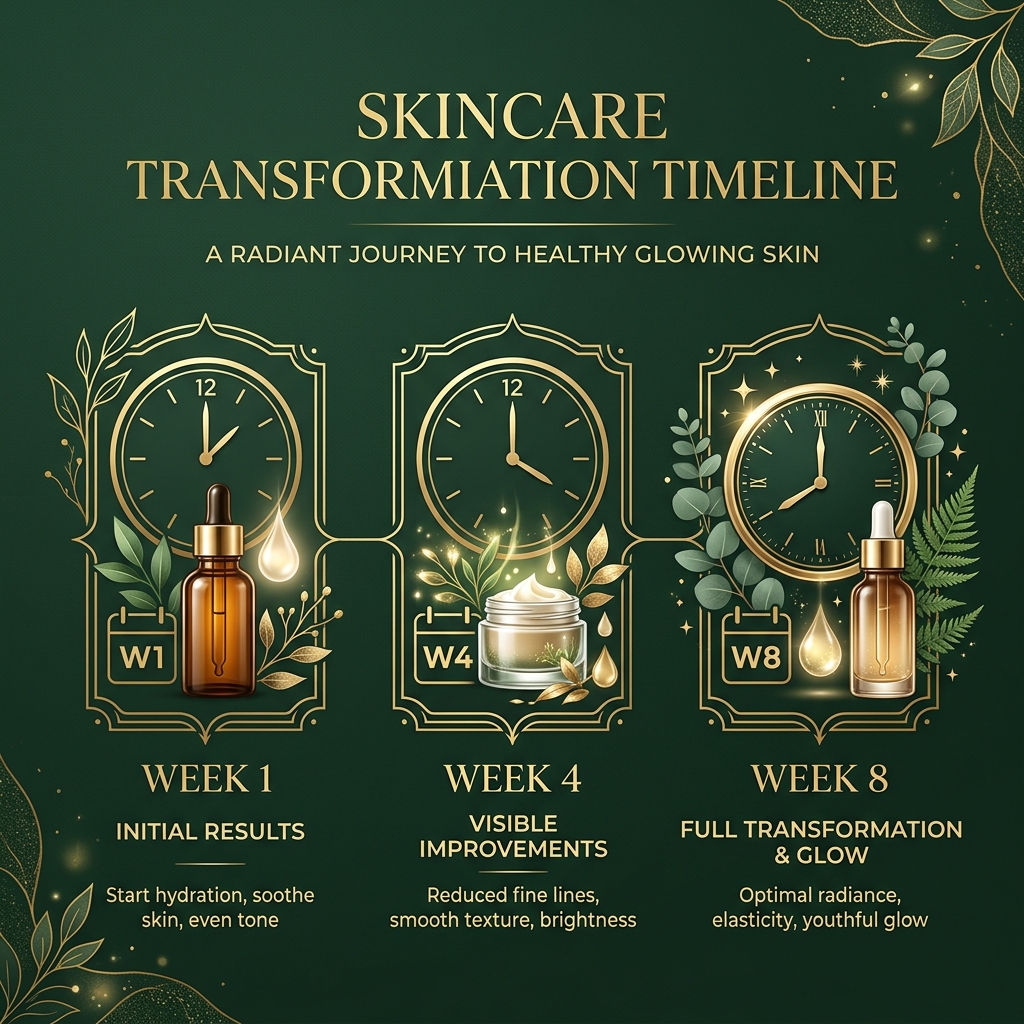
You bought the serum. You have used it faithfully every night for two weeks. You look in the mirror and see… roughly the same face you saw two weeks ago.
This is the point where most people quietly abandon a product and start shopping for the next one. It is also, in most cases, exactly the wrong moment to give up.
Most skincare products need between four and twelve weeks to produce visible results — and some need considerably longer. The reason has nothing to do with product quality and everything to do with how skin biology actually works. This guide explains those timelines ingredient by ingredient, so you know when a product is genuinely failing and when you simply have not waited long enough.
Why Skincare Takes Time: The Biology Behind the Wait
To understand skincare timelines, it helps to understand the two layers where the work happens.
The epidermis and cell turnover
Your epidermis — the outer layer of skin — is in a constant state of renewal. New keratinocytes are produced at the base, migrate upward, flatten, and eventually shed from the surface in a process called desquamation.
In healthy adult skin, this full cycle takes approximately 28 days. That number is not fixed. It shortens in children and lengthens with age — often stretching to 40 to 60 days by your fifties and beyond.
This matters because any product working on the surface of your skin — brightening, texture-smoothing, exfoliating — needs at least one full turnover cycle before the treated cells actually reach the surface where you can see them. That is your absolute minimum timeline for most visible results.
The dermis and collagen synthesis
Beneath the epidermis lies the dermis, where fibroblasts produce collagen and elastin — the proteins responsible for firmness and elasticity.
Collagen synthesis is a much slower process than cell turnover. When an ingredient like retinol or vitamin C stimulates fibroblast activity, the resulting structural change develops over months, not weeks. This is why anti-aging claims are the slowest to materialize, and why products promising firmer skin in seven days are making a claim that is biologically implausible.
The One Exception: Hydration
There is one category that works almost immediately — hydration. Humectants like hyaluronic acid and glycerin draw water into the stratum corneum, plumping the surface within minutes to hours. This is a genuine effect, but it is temporary and superficial. It does not change skin structure, and it disappears when you stop.
This distinction explains a lot of skincare disappointment: hydrating products feel like they work instantly, so people expect the same speed from actives that are doing structural work.
Realistic Expectations
True cellular turnover takes roughly 28 days for an average adult, and slows down with age. Skincare is a marathon, not a sprint.
Realistic Timelines by Ingredient
| Ingredient | First visible change | Meaningful results | Full benefit |
|---|---|---|---|
| Hyaluronic acid | Immediately | Immediately | Ongoing |
| Ceramides | 1-2 weeks | 4 weeks | 8 weeks |
| Niacinamide | 2-4 weeks | 8 weeks | 12 weeks |
| Salicylic acid (BHA) | 2-4 weeks | 8 weeks | 12 weeks |
| Glycolic acid (AHA) | 2-4 weeks | 8-12 weeks | 12+ weeks |
| Vitamin C | 3-4 weeks | 8-12 weeks | 12-16 weeks |
| Benzoyl peroxide | 2-3 weeks | 6-8 weeks | 12 weeks |
| Azelaic acid | 4 weeks | 8-12 weeks | 16 weeks |
| Retinol | 4-6 weeks | 12 weeks | 6-12 months |
| Bakuchiol | 4-6 weeks | 8-12 weeks | 6 months |
| Sunscreen | Not visible | Preventive | Lifetime |
These are general ranges based on typical clinical study durations and skin biology, not guarantees. Individual results vary based on age, skin condition, consistency of use, and concentration.
Tracking Progress
Take photos in the same lighting every week. Day-to-day changes are often imperceptible to the naked eye, leading to false disappointment.
Ingredient-by-Ingredient Breakdown
Hyaluronic acid: minutes to hours
Hyaluronic acid is a humectant capable of binding many times its weight in water. Applied to damp skin and sealed with a moisturizer, it produces visible plumping almost immediately.
What to expect: smoother, more hydrated-looking skin within hours. What not to expect: any permanent change to fine lines, tone, or texture. Hyaluronic acid hydrates; it does not remodel.
A common mistake: applying it to dry skin in a dry climate. Without ambient moisture to draw on, hyaluronic acid can pull water from deeper skin layers, leaving skin feeling tighter than before. Always apply to damp skin and seal with a moisturizer.
Ceramides and barrier repair: 1-4 weeks
Ceramides are lipids that make up a substantial portion of the skin barrier. When that barrier is compromised — from over-exfoliation, harsh cleansers, or environmental stress — transepidermal water loss increases and skin becomes reactive.
What to expect: reduced tightness and stinging within one to two weeks, with a measurably calmer barrier by four weeks. Timeline note: barrier repair is one of the faster processes in skincare, which is why it is the first thing to address when skin is irritated. Fix the barrier before adding actives.
Niacinamide: 4-12 weeks
Niacinamide is one of the most versatile ingredients available, with research supporting effects on barrier function, sebum regulation, pigmentation, and inflammation.
What to expect and when:
- Weeks 1-2: improved hydration and reduced redness in some users
- Weeks 4-8: visible reduction in pore appearance and oiliness
- Weeks 8-12: measurable improvement in hyperpigmentation
Niacinamide’s pigmentation benefits are among the slowest of its effects, because it works by inhibiting melanin transfer to keratinocytes — a process that only becomes visible after those cells cycle to the surface.
Chemical exfoliants: 2-12 weeks
Salicylic acid (BHA) is oil-soluble and penetrates into pores, making it the standard choice for congestion and blackheads. Expect smoother texture within two to four weeks, with meaningful improvement in congestion by eight weeks.
Glycolic acid (AHA) works on the skin surface, loosening the bonds between dead cells. Initial brightness can appear within days, but structural improvements in texture and tone take eight to twelve weeks.
Important caveat: exfoliants produce the fastest visible “glow,” which makes them easy to overuse. More frequent exfoliation does not accelerate results — it damages the barrier and ultimately makes skin worse. Two to three times weekly is sufficient for most people.
Vitamin C: 4-16 weeks
Vitamin C works through multiple mechanisms operating on different timelines. Antioxidant protection begins immediately but is invisible. Brightening becomes apparent around week three or four. Pigmentation fading requires eight to twelve weeks. Collagen-related firming develops over three to six months.
The most common reason vitamin C appears not to work: an oxidized product, inconsistent use, or missing sunscreen. Without daily SPF, new pigmentation forms faster than vitamin C can fade existing spots.
Retinoids: 6 weeks to 12 months
Retinoids have the longest and most misunderstood timeline in skincare.
Weeks 1-6 (retinization): Often the worst-looking phase. Dryness, flaking, and redness are common as skin adapts. Some users experience purging.
Weeks 6-12: Irritation typically settles. Texture begins improving, and acne-prone users often see clearer skin.
Months 3-6: Pigmentation fades noticeably. Fine lines begin softening.
Months 6-12: Collagen-related improvements become visible. This is where the long-term anti-aging benefit actually appears.
The key insight: most people quit retinol during the retinization phase, when skin genuinely looks worse than when they started. Pushing through that window is the difference between getting results and concluding retinol “doesn’t work for me.”
Acne treatments: 6-12 weeks
Benzoyl peroxide, azelaic acid, and topical retinoids all require a minimum of six to eight weeks before efficacy can be fairly assessed. Dermatologists typically evaluate acne treatments at the twelve-week mark for this reason.
Post-inflammatory hyperpigmentation — the marks left behind after a blemish heals — takes considerably longer, often three to six months, and sometimes longer for deeper skin tones.
Sunscreen: immediate protection, invisible results
Sunscreen is the one product where “results” are entirely preventive. You will never see what it stopped from happening. Long-term studies show consistent daily sunscreen use meaningfully reduces photoaging over years — but there is no week-four checkpoint to look for.
This is exactly why sunscreen is the easiest product to skip and the most costly to neglect.
What Actually Affects Your Personal Timeline
Age
Cell turnover slows steadily with age. A twenty-five-year-old on a 28-day cycle will see surface-level results faster than a fifty-five-year-old on a 45-day cycle using the identical product. Neither is doing anything wrong.
Consistency
This is the single largest variable. Using a product four times a week instead of daily does not produce results 60% as fast — it often produces meaningfully less than that, because many actives depend on sustained exposure to maintain their effect.
Concentration and formulation
A 0.25% retinol will work more slowly than a 0.5% formulation. A vitamin C serum in poor packaging may have oxidized before you finish it. Formulation quality affects timeline as much as ingredient choice.
The condition being treated
Surface pigmentation fades faster than deep dermal pigmentation. Mild texture irregularity resolves faster than established scarring. Fine lines respond faster than deep-set wrinkles. Matching your expectations to the severity of the concern matters.
Whether you are protecting your progress
Any active ingredient working on pigmentation is in a race against ongoing UV exposure. Without daily sunscreen, you are effectively treating and re-damaging simultaneously.
When Something Is Genuinely Not Working
Patience is necessary, but it is not unlimited. Here is how to distinguish “give it time” from “this product is wrong for you.”
STOP IMMEDIATELY IF:
- Burning, severe stinging, or swelling
- Hives, rash, or widespread redness
- Skin becomes painful, weepy, or damaged
REASSESS LATER IF:
- Irritation from a retinoid hasn't settled
- Skin barrier feels persistently compromised
- Breakouts are worsening over time
These are irritation or allergic reactions, not adjustment periods.
Reassess at 12 weeks if:
- You have used the product consistently as directed
- You have not seen any measurable change in the target concern
- Nothing else in your routine has changed
At the twelve-week mark with consistent use and no result, switching is reasonable.
How to Actually Track Progress
Judging your skin in the mirror each morning is close to useless. Change happens too gradually to perceive day to day, and lighting, sleep, hydration, and mood all distort your perception.
A more reliable approach:
- Take a baseline photo before starting anything new — same lighting, same angle, no makeup, ideally natural daylight.
- Repeat every four weeks under identical conditions.
- Compare week 0 to week 12, not week 3 to week 4.
- Keep a brief written log noting product changes, irritation, and any life factors like illness or stress that could confound results.
- Change one variable at a time. If you introduce three new products simultaneously and your skin reacts, you have no way of knowing which one caused it.
This is the single most useful habit for anyone serious about skincare, and almost nobody does it.
The Overcorrection Problem
There is a specific failure pattern worth naming, because it is extraordinarily common:
Someone starts a new product. They see nothing at week two. They add a second product to accelerate results. Still nothing at week four, so they add an exfoliant. Now their barrier is compromised, so their skin is red and reactive — which they interpret as one of the products not working, so they stop everything and start over with a completely new routine.
Six months later, they have tried a dozen products and given none of them a fair trial.
The alternative is simple and much less satisfying: pick a small routine, use it consistently, change nothing for twelve weeks, then evaluate. It requires more patience than shopping does, but it is the only approach that actually produces information you can act on.
Timelines by Product Category, Not Just Ingredient
Ingredients matter most, but the type of product also affects how quickly you see change — largely because of contact time and concentration.
Cleansers: limited impact, fast feedback
A cleanser is on your skin for perhaps sixty seconds before being rinsed away. That short contact time means active ingredients in cleansers deliver far less benefit than the same ingredients in a leave-on product.
What a cleanser can change quickly: how your skin feels immediately after washing. Switching from a stripping foaming cleanser to a gentle one can reduce tightness and reactivity within days.
What a cleanser will not do: meaningfully fade pigmentation or treat wrinkles, regardless of what the label claims.
Toners and essences: 2-8 weeks
Modern toners are typically lightweight, water-based delivery vehicles for hydrating or active ingredients. Their timeline depends entirely on what they contain — a hydrating toner works immediately, while an exfoliating toner follows acid timelines.
Serums: the primary workhorses
Serums carry the highest concentration of actives in most routines and stay on the skin. This is where the majority of visible change originates, and where the ingredient timelines above apply most directly.
Moisturizers: 1-4 weeks
A well-formulated moisturizer improves how skin feels immediately and how it functions within a few weeks. Barrier-supporting ingredients like ceramides, cholesterol, and fatty acids produce measurable improvement in barrier function within two to four weeks.
Masks: temporary, not transformative
Sheet masks and hydrating masks provide a genuine but short-lived plumping effect that lasts hours to a day. Clay masks can temporarily reduce the appearance of oiliness. Neither produces lasting structural change — they are supplements to a routine, not substitutes for one.
Eye creams: 8-12 weeks
The skin around the eyes is thinner and more delicate, and concerns there — particularly dark circles caused by underlying vascular structure or bone structure — are often not fully addressable topically at all. Puffiness may respond within days; fine lines follow standard collagen timelines of three months or more.
Frequently Asked Questions
How long does it take to see results from a new skincare routine? Most people notice initial changes in hydration and texture within two to four weeks, with meaningful improvements in tone, pigmentation, and fine lines appearing between eight and twelve weeks.
Why does my skin look worse after starting a new product? This can be purging — a temporary acceleration of existing congestion surfacing — which typically resolves within four to six weeks and occurs mainly with retinoids and exfoliating acids. If the reaction involves burning, rash, or breakouts in areas you do not normally break out, it is more likely irritation, and you should stop.
Is 28 days the standard for all skincare results? The 28-day figure refers to the average adult skin cell turnover cycle, not a universal results timeline. It represents roughly the minimum time for surface-level changes to become visible — deeper changes involving collagen take considerably longer.
How long should I use a product before deciding it does not work? Twelve weeks of consistent, correct use is the standard benchmark, unless you experience an adverse reaction, in which case stop immediately.
Does using more product make it work faster? No. Most actives have a saturation point beyond which additional product provides no benefit and only increases irritation risk. A pea-sized amount of retinol for the full face is standard regardless of concentration.
Why do results seem slower as I get older? Cell turnover slows with age — from roughly 28 days in young adults to 40-60 days in older adults. The same product genuinely takes longer to show visible results, because treated cells take longer to reach the surface.
Can I speed up results by combining more active ingredients? Usually not. Layering multiple actives frequently compromises the skin barrier, which slows healing and can worsen the concerns you are treating. A simple, consistent routine typically outperforms a complex, aggressive one.
How long do results last if I stop using a product? It depends on the mechanism. Hydration effects disappear within days. Exfoliation and brightening benefits fade over several weeks as cell turnover continues. Collagen-related improvements persist longer but gradually decline without maintenance.
The Bottom Line
Skincare is slow because skin biology is slow. Cell turnover takes about a month. Collagen synthesis takes several. No topical product, at any price, can meaningfully outpace those processes — and any product claiming otherwise is selling a story rather than a result.
Practical takeaways:
- Give any new product a minimum of 12 weeks before judging it, unless you have an adverse reaction
- Take baseline photos — your memory of what your skin looked like is not reliable
- Change one variable at a time so you can actually attribute cause
- Consistency beats intensity. A simple routine used daily outperforms an elaborate one used sporadically
- Wear sunscreen daily — it protects every other result you are working toward
The most common reason skincare “doesn’t work” is not bad products. It is unrealistic timelines, inconsistent use, and abandoning things too early.
This article is for informational purposes only and does not constitute medical advice. If you have a persistent skin concern or experience an adverse reaction to a product, consult a board-certified dermatologist.
Was this article helpful?

Anam Ahsan
Skincare Enthusiast & BloggerHi, I'm Anam! I'm a beauty and skincare enthusiast who loves testing new products and sharing honest, personal reviews. I document my skincare journey and share what works for my skin so you can make better choices for your routine.



Comments (24)
Hannah W.
2 days agoThis guide saved me so much money — went with the budget pick and honestly can't tell the difference from serums twice the price!
Anam Ahsan Author
1 day agoSo glad it worked out for you, Hannah! That's exactly the kind of result we hoped readers would see.