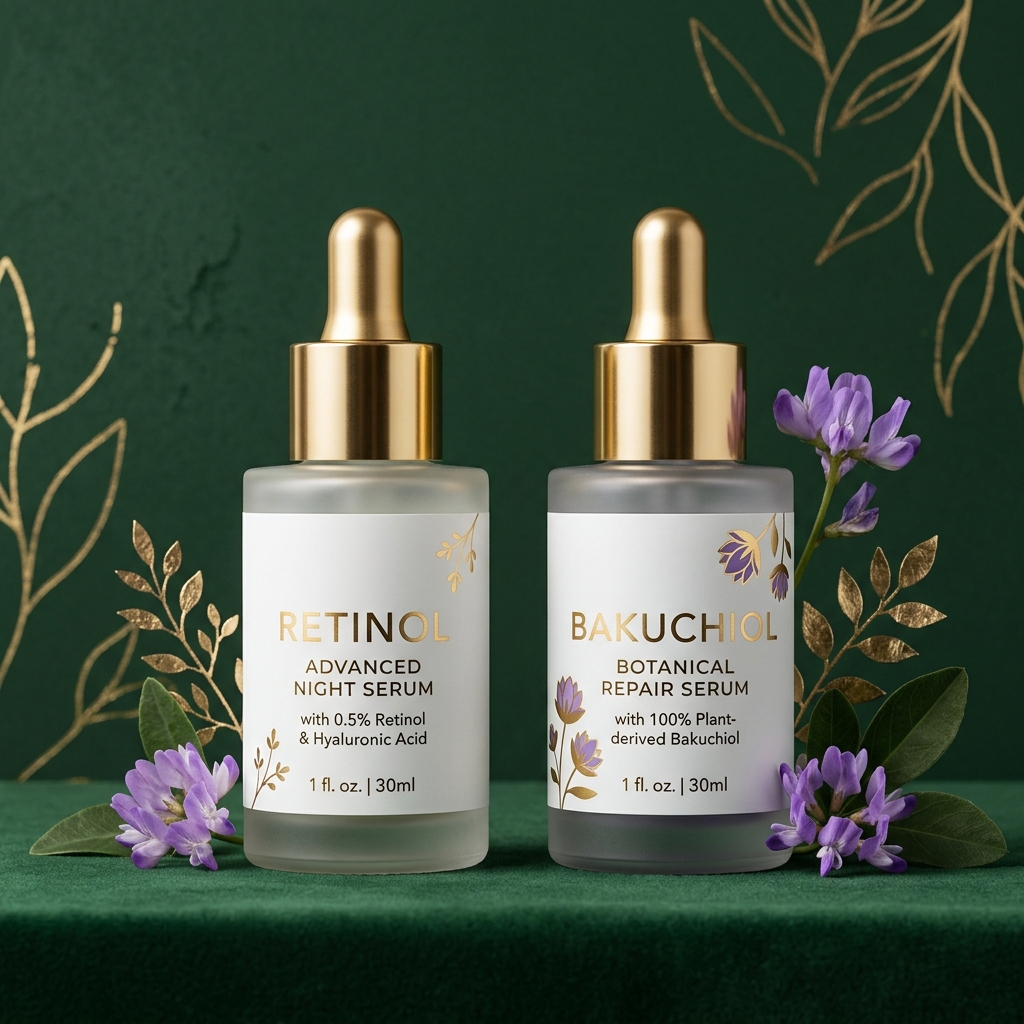
Retinol has held the title of “gold standard anti-aging ingredient” in dermatology for decades. Then bakuchiol arrived, marketed almost universally as “the natural, gentle alternative to retinol” — and the comparison has been a source of confusion ever since.
If you have sensitive skin, the question is practical rather than academic. Retinol works, but it can also mean weeks of flaking, stinging, and redness. Bakuchiol promises similar results without the irritation. But is bakuchiol actually as effective as retinol, or is it a softer option that trades results for comfort?
This guide compares both ingredients on the evidence — how they work, what the research supports, how they differ in practice, and which one makes sense for your specific skin.
Natural Alternative
Bakuchiol offers a botanical pathway to collagen stimulation without the notorious peeling and redness associated with traditional retinoids.
What Is Retinol?
Retinol is a vitamin A derivative belonging to the retinoid family. It is one of the most extensively researched ingredients in all of dermatology, with a body of clinical literature stretching back to the 1970s.
How retinol works
Retinol itself is not the active form. Once applied, skin enzymes convert it in two steps: first to retinaldehyde, then to retinoic acid, which is the biologically active molecule. Retinoic acid binds to retinoid receptors in skin cells and influences gene expression, producing several downstream effects:
- Accelerated cell turnover — the skin sheds older surface cells faster, revealing newer cells underneath
- Increased collagen synthesis — retinoids stimulate fibroblasts to produce more collagen, which is why they improve fine lines over time
- Regulated keratinization — this helps prevent the clogged pores that lead to breakouts
- Reduced melanin transfer — contributing to a gradual fading of hyperpigmentation
The retinoid family, ranked by strength
| Form | Strength | Availability |
|---|---|---|
| Retinyl palmitate | Weakest | Over the counter |
| Retinol | Moderate | Over the counter |
| Retinaldehyde | Stronger | Over the counter |
| Adapalene | Prescription-strength | Over the counter in some markets |
| Tretinoin (retinoic acid) | Strongest | Prescription only |
Each conversion step loses some potency, which is why prescription tretinoin — already in active form — is significantly stronger than over-the-counter retinol.
The trade-off: retinization
The period of adjustment when starting a retinoid is commonly called “retinization.” It typically involves dryness, flaking, redness, and increased sensitivity for anywhere from two to eight weeks. Some people also experience purging, where existing microcomedones surface faster than usual, temporarily worsening breakouts before improving.
For many people, retinization is tolerable and passes. For those with genuinely sensitive skin, rosacea, or eczema, it can be the reason retinol never becomes a sustainable part of their routine.
Patience Required
Both ingredients require long-term commitment. You won’t see collagen remodeling overnight; think in terms of months, not days.
What Is Bakuchiol?
Bakuchiol is a meroterpene phenol extracted from the seeds and leaves of Psoralea corylifolia, a plant known as babchi, long used in traditional Ayurvedic and Chinese medicine.
Despite the constant comparison, bakuchiol is not chemically related to vitamin A at all. It is not a retinoid. It has no structural similarity to retinol whatsoever.
How bakuchiol works
What makes bakuchiol interesting is that despite being structurally unrelated to retinoids, research indicates it produces functionally similar effects. Gene expression studies have found that bakuchiol upregulates several of the same pathways retinol influences — including those governing collagen types I and III production.
In other words, bakuchiol appears to arrive at a comparable destination by a different route.
Documented properties include:
- Stimulation of collagen production
- Antioxidant activity
- Anti-inflammatory effects
- Antibacterial activity relevant to acne-prone skin
- Improvement in the appearance of fine lines and pigmentation
Why it is gentler
Retinoid irritation is largely a consequence of how retinoic acid interacts with retinoid receptors and rapidly accelerates cell turnover. Because bakuchiol does not bind to those receptors in the same way, it does not trigger the same irritation cascade.
Importantly, bakuchiol also does not appear to increase photosensitivity the way retinoids do — meaning it can be used in the morning, though daily sunscreen remains essential regardless.
What the Research Actually Shows
This is the section that matters most, because marketing claims on both sides tend to overstate the case.
The key comparative study
The most frequently cited research is a 2018 randomized, double-blind study published in the British Journal of Dermatology. Participants used either 0.5% bakuchiol twice daily or 0.5% retinol once daily over 12 weeks.
The findings:
- Both groups showed statistically significant improvement in wrinkle surface area and hyperpigmentation
- There was no statistically significant difference between the two groups in those outcomes
- The retinol group reported significantly more facial skin scaling and stinging
The important caveats: the study had a relatively small sample size, ran for 12 weeks rather than a year, and used a single concentration of each ingredient. It is genuinely encouraging evidence, but it is one study — not the decades of accumulated clinical data behind retinoids.
Where the evidence stands overall
Retinol has an extensive, well-replicated body of research spanning multiple decades, larger sample sizes, longer study durations, and a wide range of concentrations and formulations. Its efficacy is not seriously disputed.
Bakuchiol has a much smaller but genuinely promising research base. Early findings are consistent and positive, but the volume of evidence does not yet match retinoids.
The Honest Summary
Retinol has stronger evidence. Bakuchiol has good evidence. For most people, either can produce visible improvement — but a dermatologist choosing purely on data would still reach for a retinoid first for someone whose skin tolerates it.
Retinol vs. Bakuchiol: Direct Comparison
| Factor | Retinol | Bakuchiol |
|---|---|---|
| Ingredient class | Vitamin A derivative | Plant-derived meroterpene |
| Research depth | Extensive, decades | Emerging, promising |
| Irritation risk | Moderate to high | Low |
| Purging period | Common, 2-8 weeks | Rare |
| Photosensitivity | Increases it | Does not appear to |
| Time of day | Night only | Morning or night |
| Results timeline | 8-12 weeks | 8-12 weeks |
| Pregnancy safe | No | Consult your doctor |
| Layering flexibility | Limited | High |
| Typical cost | Wide range | Often mid to premium |
| Stability | Degrades in light and air | More stable |
Which One Should You Choose?
Choose Bakuchiol if you:
- Have genuinely sensitive or reactive skin
- Have rosacea or eczema-prone skin
- Are new to actives entirely
- Want a morning-compatible option
- Already use several actives
- Cannot commit to a retinization period
Choose Retinol if you:
- Have resilient, non-reactive skin
- Want the most proven option
- Are treating acne alongside aging concerns
- Have tried gentler options without results
- Are prepared to build up slowly
Can you use both?
Yes, and some formulations now combine them deliberately. Bakuchiol’s anti-inflammatory properties may help buffer retinol’s irritation. A common approach is alternating nights — retinol on some evenings, bakuchiol on others — which allows the skin to recover between retinoid exposures while maintaining consistent active use.
Who Should Not Use Retinol
This is worth stating clearly, because it is the one area where the choice is not a matter of preference.
Pregnancy and breastfeeding. Oral retinoids are established teratogens, and while topical absorption is far lower, dermatologists and obstetricians routinely advise avoiding all topical retinoids during pregnancy and breastfeeding as a precaution. Bakuchiol is frequently suggested as an alternative in this context, though it has not been extensively studied in pregnancy either — so this is a conversation to have with your doctor rather than a decision to make from a blog post.
Active, inflamed skin conditions. If you are experiencing an eczema flare, active rosacea, or a compromised barrier, introducing a retinoid will typically make things worse before it makes them better.
Immediately after procedures. Following chemical peels, microneedling, waxing, or laser treatment, retinoids should be paused until the skin has fully recovered.
How to Introduce Either Ingredient Without Wrecking Your Skin
Starting retinol
- Begin with a low concentration — 0.25% or lower for sensitive skin.
- Apply twice weekly for the first two weeks, then increase gradually if tolerated.
- Use the sandwich method — moisturizer, then retinol, then moisturizer again. This buffers contact without meaningfully reducing efficacy.
- Apply to completely dry skin. Damp skin increases penetration and irritation.
- Use a pea-sized amount for the entire face. More does not work faster; it only irritates.
- Skip other actives while adjusting. No acids, no strong vitamin C, no scrubs for the first few weeks.
- Sunscreen is non-negotiable. Retinoids increase photosensitivity.
Starting bakuchiol
Bakuchiol is considerably more forgiving, but a measured approach still helps:
- Start once daily, either morning or evening.
- Patch test first — “gentle” does not mean universally tolerated, and plant-derived ingredients can still cause reactions in some people.
- Layer after water-based serums and before moisturizer.
- Wear sunscreen — not because bakuchiol increases sun sensitivity, but because sun protection is what preserves any anti-aging result you achieve.
What to Pair With Each
With retinol:
- Ceramides and niacinamide — support barrier repair during retinization
- Hyaluronic acid — offsets the dryness retinoids cause
- Avoid in the same routine: strong AHAs/BHAs, benzoyl peroxide, high-concentration vitamin C
With bakuchiol:
- Vitamin C — layers well, and the antioxidant pairing is complementary
- Niacinamide — well-tolerated combination
- Peptides — often formulated together for collagen support
- Generally flexible — bakuchiol’s low irritation profile makes it one of the easier actives to combine
Realistic Expectations and Timelines
Neither ingredient produces overnight results, and this is where most people give up prematurely.
Weeks 1-4: Little visible change. With retinol, this is typically the adjustment phase where irritation peaks. With bakuchiol, most people notice nothing dramatic yet.
Weeks 4-8: Texture often begins improving. Skin may look slightly smoother and more even. Retinol users generally find irritation settling by this point.
Weeks 8-12: This is where meaningful change tends to appear — reduced fine lines, more even tone, fading pigmentation.
Beyond 12 weeks: Both ingredients continue delivering cumulative benefit with sustained use. Collagen-related improvements in particular develop over months rather than weeks.
The most common mistake with both ingredients is inconsistency. Using an active sporadically for three months produces far less benefit than using a gentler option consistently.
What to Look For When Buying Either Product
Evaluating a retinol product
Check the concentration. Brands that disclose their percentage are generally more trustworthy than those using vague phrasing like “retinol complex.” For beginners, 0.25% to 0.3% is a sensible starting point. Experienced users often work up to 0.5% or 1%.
Check the retinoid form. Retinyl palmitate is the weakest and often used to make a product technically “retinol-containing” without delivering much benefit. Retinol and retinaldehyde are meaningfully stronger.
Check the packaging. Like vitamin C, retinol degrades with light and air exposure. Opaque tubes and airless pumps preserve potency far better than clear jars.
Check the supporting formula. Products that pair retinol with ceramides, niacinamide, or peptides tend to be better tolerated because the supporting ingredients help maintain the skin barrier during retinization.
Consider encapsulated retinol. Encapsulation technology releases the active more gradually, which typically reduces irritation without significantly compromising results. It often costs more but is worth considering for sensitive skin.
Evaluating a bakuchiol product
Check the concentration. Most research uses 0.5% to 1% bakuchiol. Products listing bakuchiol far down the ingredient list may contain too little to be effective.
Watch for “bakuchiol” used as a marketing hook. Some products advertise bakuchiol prominently while including only a trace amount alongside a base of unremarkable ingredients. Ingredient list position is a reasonable proxy for concentration.
Check the base formula. Because bakuchiol is often marketed to sensitive skin, a formula loaded with fragrance or drying alcohol defeats the purpose. Read past the front label.
Be cautious with “babchi oil” products. Bakuchiol is an isolated compound extracted from Psoralea corylifolia. Raw babchi oil contains other compounds — including psoralens — that can cause photosensitivity reactions. Purified bakuchiol is the safer, better-studied form.
Common Mistakes People Make With Both Ingredients
1. Using too much, too soon. More product does not accelerate results. With retinol especially, aggressive early use is the fastest route to a damaged barrier and an abandoned routine.
2. Assuming irritation means it’s working. Mild dryness during retinization is expected. Ongoing burning, persistent redness, or peeling that never settles is barrier damage, not progress.
3. Stacking too many actives. Adding retinol on top of an existing routine with acids, vitamin C, and exfoliants overwhelms most skin. Introduce one active at a time.
4. Skipping sunscreen. With retinol this is especially critical due to increased photosensitivity, but it applies to bakuchiol too — UV damage undoes collagen benefits faster than either ingredient can build them.
5. Switching products too frequently. Both ingredients require 8-12 weeks to demonstrate results. Abandoning a product after three weeks and starting another restarts the clock without ever reaching the payoff.
6. Ignoring the rest of the routine. An active ingredient works best in the context of a functioning skin barrier. A gentle cleanser, a good moisturizer, and consistent sun protection are what make actives effective, not optional extras.
Frequently Asked Questions
Is bakuchiol as effective as retinol? Research suggests bakuchiol produces comparable improvements in fine lines and pigmentation with significantly less irritation. However, retinol has a substantially larger evidence base. For resilient skin, retinol likely remains the stronger option; for sensitive skin, bakuchiol is a genuinely credible alternative rather than a marketing gimmick.
Can I use retinol and bakuchiol together? Yes. Some products combine them, and bakuchiol’s anti-inflammatory properties may help reduce retinol-related irritation. Alternating nights is another practical approach.
Does bakuchiol cause purging? Purging is rare with bakuchiol because it does not accelerate cell turnover as aggressively as retinoids do. Any breakouts after starting bakuchiol are more likely a reaction to another ingredient in the formula.
Is bakuchiol safe during pregnancy? Bakuchiol is often suggested as a pregnancy-friendly alternative to retinoids, but it has not been extensively studied in pregnant populations. Consult your doctor or obstetrician before using any active ingredient during pregnancy.
Can I use bakuchiol in the morning? Yes. Unlike retinoids, bakuchiol does not appear to increase photosensitivity, so morning use is fine. Sunscreen is still essential.
How long before I see results from bakuchiol? Most research and user reports point to visible improvement around 8-12 weeks of consistent daily use, which is comparable to retinol’s timeline.
Why does my skin peel on retinol? Peeling is part of retinization — the adjustment period as your skin adapts to accelerated cell turnover. It typically resolves within 2-8 weeks. If it persists beyond that or becomes severe, reduce frequency or lower the concentration.
Is bakuchiol natural, and does that make it safer? Bakuchiol is plant-derived, but “natural” does not automatically mean safer or gentler. Poison ivy is natural too. Bakuchiol’s gentleness comes from its specific mechanism of action, not from its plant origin. Patch testing is still advisable.
Final Verdict
For sensitive skin specifically, bakuchiol is the more practical choice. The available research supports meaningful results with a fraction of the irritation, and the flexibility to use it morning or night alongside other actives makes it easier to build a sustainable routine.
For resilient skin seeking maximum results, retinol remains the stronger option — its evidence base is deeper, its effects are typically more pronounced, and its acne benefits are better documented.
But the most useful framing is not which ingredient is objectively superior. It is which one you will actually use consistently for six months. An ingredient that irritates your skin into abandoning it after three weeks delivers nothing, regardless of how strong the clinical data behind it looks.
If retinol has failed you before because of irritation, bakuchiol is worth a genuine try. If you have never used either and your skin handles actives well, retinol offers the most proven path. And if you are unsure, starting gentle and escalating later is almost always the better sequence.
This article is for informational purposes only and does not constitute medical advice. If you are pregnant, breastfeeding, or have a diagnosed skin condition, consult a board-certified dermatologist before starting any new active ingredient.
Sources referenced include peer-reviewed dermatological literature, notably Dhaliwal et al., “Prospective, randomized, double-blind assessment of topical bakuchiol and retinol for facial photoageing,” British Journal of Dermatology, 2019. Add direct citation links before publishing.
Was this article helpful?

Anam Ahsan
Skincare Enthusiast & BloggerHi, I'm Anam! I'm a beauty and skincare enthusiast who loves testing new products and sharing honest, personal reviews. I document my skincare journey and share what works for my skin so you can make better choices for your routine.



Comments (24)
Hannah W.
2 days agoThis guide saved me so much money — went with the budget pick and honestly can't tell the difference from serums twice the price!
Anam Ahsan Author
1 day agoSo glad it worked out for you, Hannah! That's exactly the kind of result we hoped readers would see.