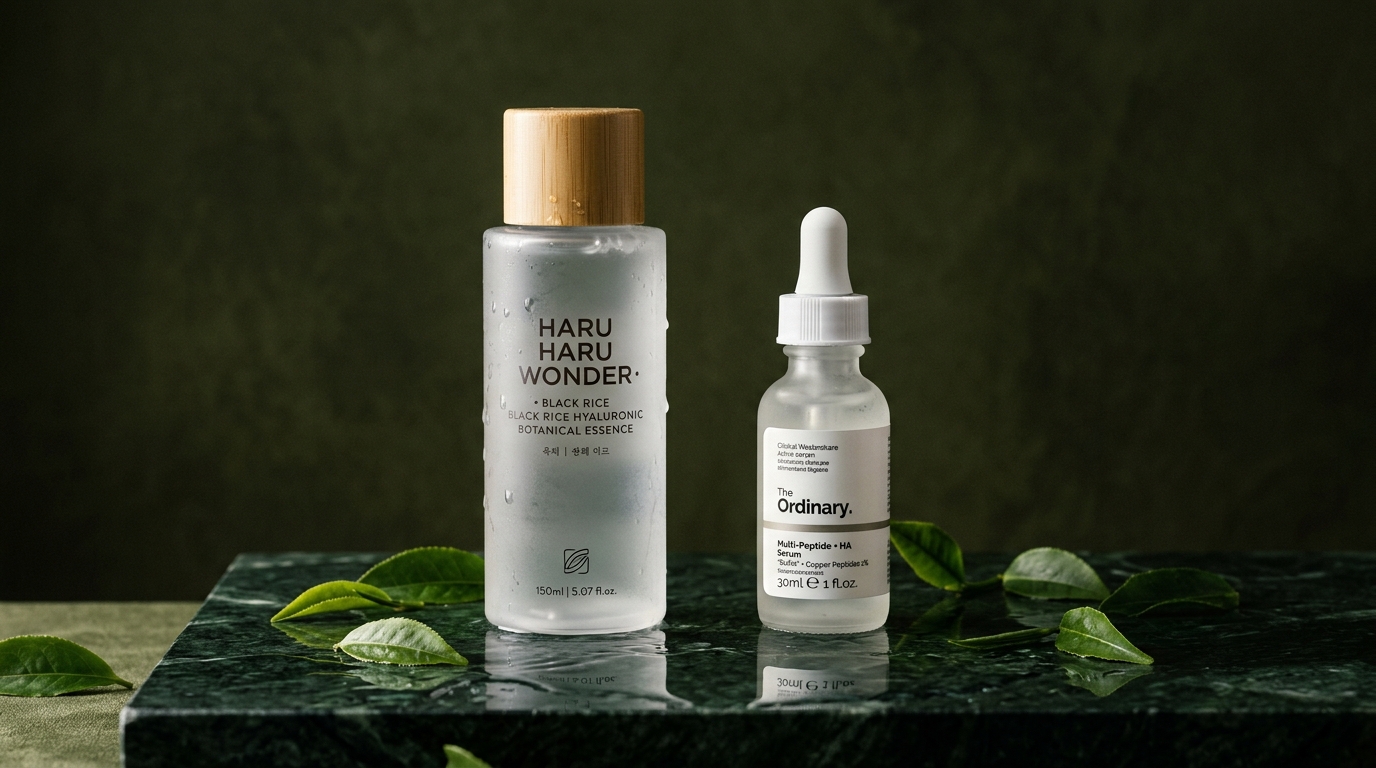
Korean skincare arrived in Western markets with an unfamiliar vocabulary — essences, ampoules, emulsions, ten-step routines — and a genuinely different aesthetic goal. It has since become one of the more polarizing topics in skincare discussion.
One camp treats K-beauty as clearly superior: gentler, more innovative, more advanced. The other dismisses it as marketing built on unnecessary steps and ingredients with little evidence behind them.
Both positions overstate the case. The underlying science is largely the same — skin biology does not differ by continent. What genuinely differs is philosophy, product format, regulatory environment, and market structure. Some of those differences matter considerably. Others are cosmetic.
This guide covers what actually distinguishes the two approaches, where each has real advantages, and how to take what is useful from both.
Key Takeaway
K-beauty and Western skincare are not competing systems — they are complementary approaches. The smartest routine borrows the best of both: K-beauty’s gentle hydration focus and Western dermatology’s evidence-backed actives.
The Philosophical Difference
This is the most substantive distinction, and it shapes everything else.
K-beauty: prevention and maintenance
Korean skincare has traditionally emphasized preventing damage and maintaining barrier health over correcting existing problems. The underlying logic is that consistent gentle care over years produces better long-term outcomes than aggressive intervention after damage appears.
How this shows up in practice:
- Heavy emphasis on hydration, layered in multiple light applications
- Strong cultural priority on daily sun protection, starting young
- Gentler active concentrations used more consistently over longer periods
- Barrier support treated as foundational rather than remedial
- Skincare framed as routine self-care rather than problem-solving
Western skincare: correction and treatment
Western skincare, particularly in the US, has developed with more emphasis on treating identified concerns with clinically proven actives.
How this shows up in practice:
- Higher concentrations of established actives
- Dermatologist-led, prescription-adjacent approach
- Focus on measurable outcomes for specific concerns
- Products marketed around problems — visible aging, blemishes, uneven tone
- Preference for ingredients with substantial clinical trial data
Which is better?
Neither, and framing it that way misses the point.
Prevention is genuinely more effective than correction for photoaging. Consistent sunscreen and barrier care from a young age prevents damage that no serum reverses.
But established actives genuinely work, and for existing concerns — significant hyperpigmentation, stubborn blemishes, established fine lines — gentle hydration alone will not resolve them.
The sensible synthesis: preventive habits as your foundation, targeted actives for concerns you actually have. That is not a compromise between two systems — it is what skincare experts generally recommend regardless of geography.
What to do
- Embrace layering with lightweight products: K-beauty essences and serums build hydration without heaviness.
- Use Korean sunscreens: Often lighter, more elegant, and easier to reapply than many Western formulas.
- Follow the glass skin prep philosophy: Hydrated, barrier-healthy skin responds better to actives.
What to avoid
- Following 10-step routines blindly: More steps does not mean more results — it often means more irritation.
- Ignoring Western clinical actives: Targeted, proven exfoliants have decades of evidence.
- Expecting instant transformation: Neither system produces glass skin overnight — consistency is what works.
The Product Categories That Confuse People
K-beauty introduced product formats without clear Western equivalents. Here is what they actually are.
Toner
In K-beauty: a hydrating step applied after cleansing to add lightweight moisture and prepare skin for subsequent layers.
In older Western usage: an astringent, often alcohol-based, intended to remove residue and “tighten” pores.
These are genuinely different products sharing a name, which causes considerable confusion. Modern Western toners have largely moved toward the hydrating model.
Essence
A lightweight, watery product typically containing hydrating and sometimes fermented ingredients. It sits between toner and serum in weight.
Honest assessment: an essence is essentially a lightweight, lower-concentration serum. It is a genuine product category, but the distinction from a hydrating serum is more about texture and concentration than fundamental difference.
Ampoule
A more concentrated treatment product, positioned between an essence and a serum in potency — or sometimes above a serum, depending on the brand.
Honest assessment: the terminology is not standardized. “Ampoule” broadly means “concentrated treatment,” which is also what serum means. Read ingredient lists rather than relying on category names.
Emulsion
A lightweight moisturizer, generally lighter than a cream but more substantial than a serum.
Honest assessment: this is a moisturizer. The distinction is texture, not function.
Sheet masks
Fabric or hydrogel sheets saturated with essence, left on for 15-20 minutes.
Honest assessment: they provide a genuine short-term hydration boost through occlusion. The effect lasts hours to a day. They are pleasant and useful before events, but they do not produce lasting change.
The general point: several K-beauty categories are variations on hydration and treatment products that Western skincare packages differently. The proliferation of categories is partly formulation innovation and partly market differentiation.
The Ten-Step Routine: Reality Check
The famous ten-step routine is the most recognizable and most misunderstood aspect of K-beauty.
A few points worth making clear:
Most Korean people do not use ten steps daily. This is a maximalist framework popularized in marketing, not a description of typical daily practice.
The steps are modular, not mandatory. The framework describes available categories, from which people select what suits their skin.
Many steps are variations of the same function. Toner, essence, ampoule, and serum all deliver water-based ingredients. Using all four is layering rather than adding distinct benefits.
More steps carry real costs — cost, time, and increased irritation risk from more ingredients contacting your skin.
What the framework gets right
Despite the excess, the underlying sequence is sound: cleanse thoroughly, hydrate in light layers, seal, protect.
The emphasis on hydration layering has genuine merit for dry skin and dry climates. Several thin layers can be more comfortable and effective than one heavy application.
What a reasonable version looks like
Morning: Cleanse → hydrating layer → moisturizer → sunscreen
Evening: First cleanse → second cleanse → treatment → hydrating layer → moisturizer
That is four to five steps, captures the useful elements, and is sustainable.
Where K-Beauty Has Genuine Advantages
Sunscreen — the clearest case
This is the most significant practical difference, and it is regulatory rather than cultural.
Korean sunscreens have access to UV filters unavailable in the US, including bemotrizinol and bisoctrizole. These are highly photostable, provide excellent UVA coverage, and allow cosmetically elegant textures.
The practical result: Korean sunscreens are frequently lighter, more comfortable, and leave less cast than American equivalents — while providing comparable or better protection.
Why this matters more than it sounds: sunscreen protects you only if you wear it. A texture you enjoy is a genuine protection factor, not a vanity concern.
Also worth noting: the PA rating system used in Korea and Japan communicates UVA protection more precisely than the binary “broad-spectrum” label used in the US.
Texture and formulation elegance
Korean formulations generally prioritize sensory experience — lightweight textures, fast absorption, comfortable finishes. This is not superficial. Products that feel good get used consistently, and consistency determines results.
Barrier-focused ingredients
Ingredients like centella asiatica, madecassoside, and panthenol appear widely in Korean formulations, with reasonable evidence for soothing and barrier support. Western skincare has adopted many of these, having historically focused more heavily on actives.
Sunscreen as a daily habit
The cultural norm of daily sun protection from a young age is arguably the single largest contributor to differences in long-term skin appearance. This is a habit, not a product.
Accessible innovation
Korean brands typically iterate faster and price more accessibly. Effective, well-formulated products at modest prices are widely available.
Where Western Skincare Has Genuine Advantages
Access to high-strength actives
Specialized, high-strength exfoliating treatments are more readily available in Western markets.
For stubborn blemishes, significant uneven tone, or meaningful anti-aging goals, these are highly effective.
Higher over-the-counter active concentrations
Western products frequently contain higher concentrations of retinol, vitamin C, and exfoliating acids. For someone with a specific concern and resilient skin, this can produce faster results.
Stronger clinical research emphasis
Western brands more commonly conduct and publish clinical efficacy studies. This does not mean Korean products are ineffective, but the evidence base is more accessible for some Western formulations.
Ingredient transparency
Concentration disclosure is more common in Western products, particularly among brands positioned around ingredient transparency. Korean products more often list ingredients without percentages.
Dermatologist-led guidance
The Western model of treating skin concerns as medical issues managed by dermatologists produces better outcomes for genuine conditions — acne, rosacea, eczema — than a consumer skincare approach.
Ingredients That Cause Debate
Snail mucin
The claim: hydration, healing, and improved texture.
The evidence: some research supports moisturizing and wound-healing properties. Studies are limited in size, and much of the research is industry-linked.
Honest assessment: likely a decent hydrating ingredient. Not a transformative one, and not clearly superior to well-established humectants.
Centella asiatica
The claim: soothing, barrier repair, anti-inflammatory.
The evidence: reasonably good. Centella has research supporting wound healing and anti-inflammatory effects, and is used medicinally beyond cosmetics.
Honest assessment: one of the better-supported K-beauty ingredients, and it has been widely adopted in Western formulations as a result.
Propolis
The claim: antibacterial and soothing.
The evidence: some antibacterial research exists. It is also a known allergen for some people, particularly those sensitive to bee products.
Honest assessment: possibly useful, worth patch testing.
Fermented ingredients
The claim: improved absorption and additional benefits from fermentation.
The evidence: fermentation can alter molecular size and produce additional compounds. Whether this translates to meaningfully better skin outcomes is not well established.
Honest assessment: plausible mechanism, limited proof of superior results.
Ginseng
The claim: antioxidant and anti-aging.
The evidence: antioxidant activity is documented. Evidence for meaningful anti-aging effects from topical application is limited.
Honest assessment: likely a reasonable antioxidant, not a substitute for established actives.
The overall pattern: K-beauty ingredients are generally gentle and often reasonably supported for hydration and soothing. They tend to have less robust evidence for correcting established concerns than retinoids, vitamin C, or exfoliating acids.
Building a Routine That Takes From Both
The useful approach is not choosing a side.
Take from K-beauty:
- Daily sunscreen as a non-negotiable habit, ideally a formulation you enjoy wearing
- Emphasis on hydration and barrier health
- Gentle, consistent application rather than aggressive intervention
- Attention to product texture, since it drives adherence
- Prevention starting before problems appear
Take from Western skincare:
- Evidence-based actives for concerns you actually have
- Willingness to see a dermatologist for genuine skin conditions
- Attention to ingredient concentrations
- Skepticism toward claims without supporting evidence
A practical combined routine:
Morning: Gentle cleanse → hydrating layer → moisturizer → sunscreen (Korean or European filter technology if accessible)
Evening: First cleanse if wearing sunscreen or makeup → gentle second cleanse → active treatment (retinoid or acid) → hydrating layer → moisturizer
This takes the preventive foundation from one approach and the corrective tools from the other.
The Regulatory Difference Explained
Much of what distinguishes these two categories comes down to how each market regulates cosmetics — a detail that explains more than any philosophical framing.
In South Korea, cosmetics are regulated by the Ministry of Food and Drug Safety. Sunscreens are classified as functional cosmetics, with a safety-assessment pathway that allows new UV filters to reach market relatively efficiently once demonstrated safe.
In the United States, sunscreens are regulated as over-the-counter drugs. New filter approvals require extensive clinical data through a pathway that has effectively stalled — the permitted filter list has not been meaningfully expanded in decades.
The consequences are concrete:
Korean and Japanese formulators can build sunscreens around bemotrizinol, bisoctrizole, and other modern filters that are photostable, provide strong UVA coverage, and feel light on the skin. American formulators work with an older filter set, which is why US chemical sunscreens more often feel heavy, greasy, or unpleasant.
This is not a difference in skill. It is a difference in available chemistry.
A similar dynamic affects actives in reverse. Prescription tretinoin, higher-strength azelaic acid, and specialized blemish treatments are more accessible through the Western dermatology model, while Korean over-the-counter products generally use lower concentrations.
Understanding this reframes the debate usefully: neither market has better science. Each has different regulatory constraints producing different strengths.
Practical Considerations When Buying
If you decide to incorporate products from either market, a few practicalities are worth knowing.
Authenticity. Counterfeit skincare is a genuine problem, particularly for popular imported products sold through marketplace sellers. Buy from established retailers or authorized distributors rather than unfamiliar sellers offering steep discounts.
Shipping and storage conditions. Products shipped internationally may spend time in unregulated temperatures. Heat degrades sunscreen filters and unstable actives. This is a real consideration for anything vitamin C or SPF related.
Batch age. Imported products sometimes sit in warehouses before reaching you. Checking the batch code, where you can decode it, tells you the manufacturing date.
Ingredient list language. Korean products sold internationally usually carry INCI names, which are standardized. Products bought domestically in Korea may list ingredients only in Korean, making them harder to evaluate.
Fragrance. A common misconception is that Korean products are universally gentle. Many contain fragrance or essential oils. If your skin is reactive, read the full ingredient list regardless of origin.
Return policy. Imported products are often harder to return, which makes patch testing and starting with smaller sizes more important than usual.
Availability consistency. Products discontinued or reformulated in their home market may become difficult to source. If something works well for you, that is worth factoring into how much you build your routine around it.
The One Technique Worth Borrowing
If you take a single practical method from Korean skincare, hydration layering is the strongest candidate — and it is genuinely useful for dry skin and dry climates.
The principle: rather than applying one heavy moisturizer, apply several thin layers of lightweight hydration, allowing each to absorb partially before the next.
Why it works better for some people: a single heavy application can sit on the surface, feel greasy, and pill under makeup. Multiple thin layers absorb more completely and build hydration progressively without the heaviness.
How to do it:
- Start with damp skin after cleansing — do not dry completely.
- Apply your first hydrating layer — a watery toner or essence — by pressing it into the skin with your palms rather than rubbing.
- Wait roughly 30 seconds, until it feels absorbed but skin still feels slightly moist.
- Apply the next layer. Two to three layers is sufficient for most people.
- Seal with moisturizer. This step is not optional — without an occlusive layer, the hydration you have built evaporates.
Who benefits most: dry skin, dehydrated skin, anyone in a cold or arid climate, and anyone whose skin feels tight despite using moisturizer.
Who does not need it: oily skin in humid conditions, and anyone whose current routine already leaves skin comfortable. Additional layers add time and cost without benefit if hydration is not your limiting factor.
An honest caveat: the returns diminish quickly. Three layers is not three times better than one. The technique helps when a single application is genuinely insufficient — not as a universal upgrade.
Frequently Asked Questions
Is Korean skincare better than Western skincare? Neither is universally better. Korean skincare generally excels at sunscreen formulation, texture, and preventive hydration. Western skincare offers stronger access to prescription actives and higher over-the-counter concentrations. The best routine takes from both.
Do I need to do all ten steps? No. The ten-step framework is a menu of categories, not a daily requirement. Four to five well-chosen steps deliver nearly all the benefit.
What is the difference between an essence and a serum? Essences are typically lighter and less concentrated; serums are more concentrated and targeted. The distinction is not standardized across brands, so ingredient lists are more informative than category names.
Are Korean sunscreens actually better? Often, yes — but for regulatory rather than formulation-skill reasons. Korean sunscreens have access to newer UV filters unavailable in the US, allowing lighter textures with excellent protection.
Does snail mucin actually work? It appears to be a reasonable hydrating ingredient with some evidence for wound healing. It is not transformative, and it does not outperform well-established humectants in any clearly demonstrated way.
Is K-beauty better for sensitive skin? Often it suits sensitive skin well, since formulations tend to emphasize gentleness and barrier support. However, some products contain fragrance or essential oils, so ingredient lists still matter.
Can I mix Korean and Western products? Yes. Products do not conflict by origin. Normal layering principles apply — thinnest to thickest, sunscreen last, avoid stacking irritating actives.
Why do Korean products not list concentrations? Disclosure norms differ by market and brand. Concentration transparency is more common among Western brands positioned specifically around that. This is a genuine drawback when comparing products.
Is glass skin achievable for everyone? The glass skin aesthetic — smooth, luminous, poreless-looking — depends significantly on skin type, genetics, pore size, and often makeup and photography. Good hydration and consistent care improve skin appearance considerably, but the idealized version circulating online is not a realistic universal target.
The Bottom Line
The K-beauty versus Western skincare debate generates more argument than the underlying differences justify. Skin biology is the same everywhere. Hydration, barrier support, sun protection, and evidence-based actives work regardless of where a product was formulated.
The genuine differences worth knowing:
K-beauty’s real advantages: superior sunscreen filter access, more elegant textures, stronger preventive culture, and accessible innovation.
Western skincare’s real advantages: high-strength actives, higher over-the-counter concentrations, greater concentration transparency, and highly targeted formulas for specific concerns.
What is largely marketing on both sides: proliferating product categories that overlap in function, “advanced technology” claims without published evidence, and the implication that a country of origin determines a product’s quality.
The most useful takeaway is the philosophical one: prevention genuinely outperforms correction. Daily sunscreen, consistent barrier care, and gentle habits maintained over years will do more for your skin than any corrective product applied after damage has accumulated.
That principle does not belong to either tradition. It is just what the evidence supports.
Was this article helpful?
Anam Ahsan
Skincare Enthusiast & BloggerHi, I'm Anam! I'm a beauty and skincare enthusiast who loves testing new products and sharing honest, personal reviews. I document my skincare journey and share what works for my skin so you can make better choices for your routine.


Comments (24)
Hannah W.
2 days agoThis guide saved me so much money — went with the budget pick and honestly can't tell the difference from serums twice the price!
Anam Ahsan Author
1 day agoSo glad it worked out for you, Hannah! That's exactly the kind of result we hoped readers would see.