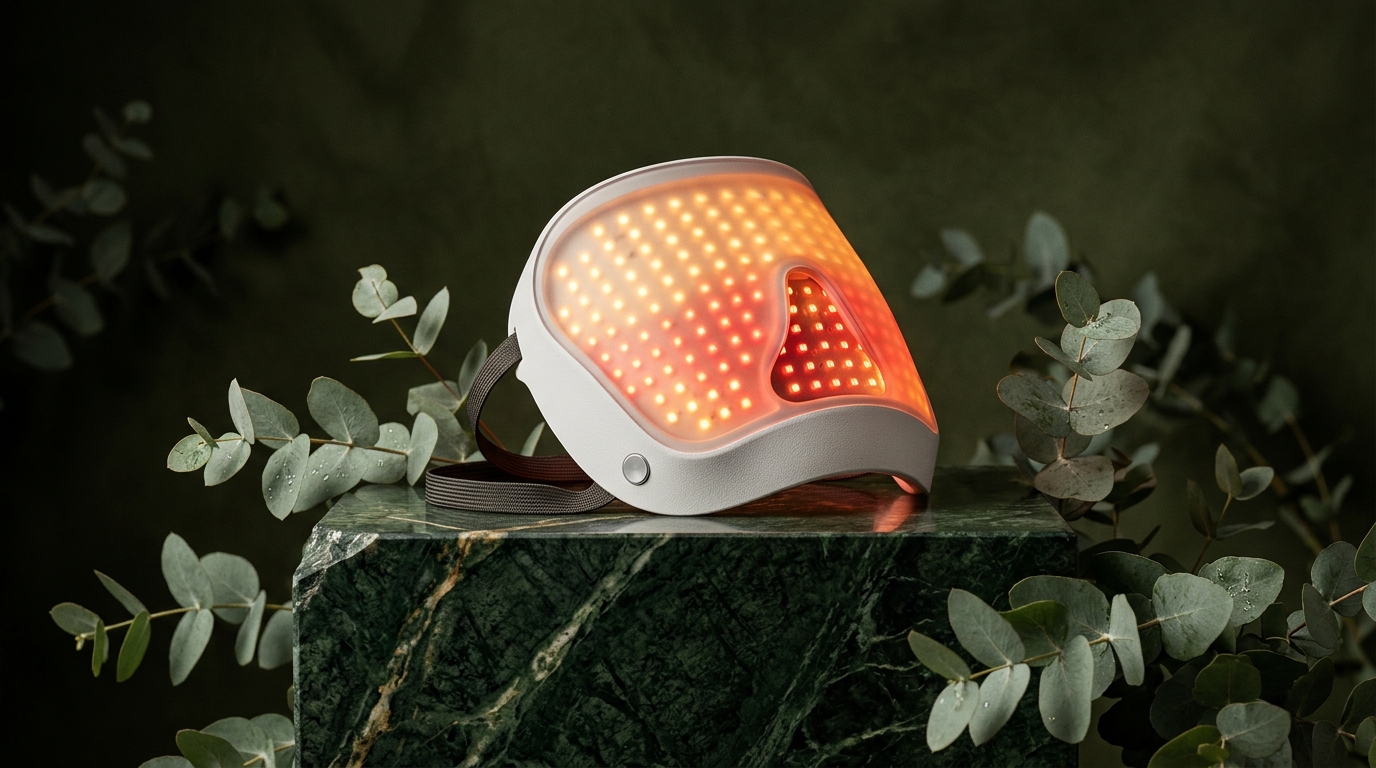
LED face masks have moved from skincare studios to bathroom shelves, and the marketing around them is confident: collagen stimulation, imperfection clearance, reduced redness, all from sitting still for ten minutes.
They are also expensive — frequently the single largest purchase in a skincare routine.
So the question deserves a careful answer rather than an enthusiastic or a dismissive one.
The underlying science, called photobiomodulation, is genuine and studied. But there is a substantial gap between what clinical devices achieve under controlled conditions and what a consumer mask delivers in your bathroom. Understanding that gap is the difference between a reasonable purchase and an expensive disappointment.
This guide covers how LED therapy actually works, what the evidence supports for each wavelength, how consumer devices differ from clinical ones, and whether one is worth your money.
Key Takeaway
Consumer LED masks deliver a diluted version of clinical therapy. They can provide modest improvements in redness and imperfections over months of use, but they will not replace a solid skincare routine or give you a facelift.
How LED Therapy Actually Works
The mechanism is called photobiomodulation — using specific wavelengths of light to influence cellular activity without heat or damage.
The cellular mechanism
Red and near-infrared light are absorbed by cytochrome c oxidase, an enzyme in the mitochondria of your cells. This absorption appears to increase the production of adenosine triphosphate — the molecule cells use for energy.
The proposed downstream effect is that cells with more available energy function more efficiently. In skin, that means fibroblasts potentially producing more collagen and elastin, and faster tissue repair.
Blue light works differently. It is absorbed by porphyrins — compounds produced by Cutibacterium imperfectionss, the bacteria involved in persistent redness. This absorption generates reactive oxygen species that damage the bacteria.
Neither mechanism involves heat or UV radiation. LED therapy is not related to tanning or laser treatment, and does not carry the same risks.
Why wavelength matters more than colour
Marketing describes lights by colour, but the specific wavelength — measured in nanometres — determines what the light does and how deeply it penetrates.
| Wavelength | Colour | Penetration | Primary target |
|---|---|---|---|
| 415-450 nm | Blue | Surface | imperfections bacteria |
| 520-560 nm | Green | Shallow | Pigmentation (limited evidence) |
| 590-620 nm | Amber/yellow | Shallow | Redness (limited evidence) |
| 630-660 nm | Red | Moderate | Collagen, redness |
| 800-880 nm | Near-infrared | Deep | Deeper tissue repair |
A device listing “red light” without specifying the wavelength is telling you very little. The research is wavelength-specific, and a device operating outside the studied ranges cannot claim the benefits from those studies.
What the Evidence Supports
The evidence varies considerably by application, and being specific is more useful than a general verdict.
Blue light for imperfections — the strongest case
Blue light therapy for mild to moderate persistent redness has reasonable clinical support. Multiple studies have found reductions in visible redness, and the mechanism is well characterized.
Realistic expectation: improvement in persistent redness with consistent use over several weeks. It is generally less effective than benzoyl peroxide or a topical retinoid, and it does not address comedonal imperfections — blackheads and closed comedones — since those are not bacterially driven.
Where it fits: as a complement to topical treatment, particularly for people who cannot tolerate stronger actives, or alongside them for persistent redness.
Red light for collagen and aging — moderate evidence
Red light therapy for skin rejuvenation has been studied with generally positive results — improvements in fine lines, skin texture, and firmness reported across several trials.
The caveats matter:
- Study sizes are typically small
- Many are industry-funded
- Clinical devices deliver considerably more energy than consumer masks
- Results are modest rather than transformative
Realistic expectation: subtle improvements in texture and fine lines over months of consistent use. Not comparable to a retinoid, and certainly not comparable to procedural treatments.
Red light for redness and healing — reasonable evidence
Photobiomodulation has a substantial research base in skin recovery and redness reduction, much of it in clinical settings.
This is arguably where consumer devices have the most credible application — calming redness and supporting recovery, rather than dramatic anti-aging.
Other wavelengths — limited evidence
Green light for pigmentation and amber light for redness appear in multi-wavelength devices but have considerably less supporting research than red and blue.
Devices offering seven or eight colours are generally offering marketing variety rather than seven or eight evidence-backed treatments.
The Consumer vs. Clinical Gap
This is the part that most reviews skip, and it is the most important consideration.
Irradiance and dose
The energy a device delivers is measured as irradiance — milliwatts per square centimetre — and the total dose as fluence, in joules per square centimetre.
Clinical devices typically deliver substantially higher irradiance than consumer masks. A professional LED panel in a dermatology practice may deliver several times the energy output of a home device.
Why this matters: photobiomodulation appears to have a dose-response relationship. Too little energy produces no meaningful effect. This means the studies demonstrating benefit may not apply to a lower-powered consumer device.
The practical problem: most consumer devices do not disclose their irradiance. Without that figure, you cannot assess whether the device delivers a therapeutic dose or a cosmetic light show.
What to ask before buying
- What specific wavelengths does it emit? Numbers, not colours.
- What is the irradiance? If the manufacturer does not state it, that is informative in itself.
- Is it cleared by a relevant regulatory body? In the US, FDA clearance for a specific indication is meaningful. General “registered” language is not the same thing.
- What treatment time and frequency does it specify? Devices requiring twenty minutes daily are asking for a substantial time commitment.
- Does it cover the areas you want treated? Some masks leave gaps around the eyes, nose, or jawline.
What to do
- Use consistently: 3-5 times a week is required for results.
- Apply on clean, bare skin: Products can block light penetration.
- Check the wavelengths: Ensure it targets your specific concern (e.g., blue for imperfections, red for collagen).
What to avoid
- Expecting immediate miracles: Results take weeks to months to appear.
- Using photosensitizing products before: Wait to apply retinoids or acids until *after* the session.
- Overpaying for mystery specs: Avoid expensive masks that don't disclose their irradiance and wavelengths.
What LED Masks Will and Will Not Do
Reasonable expectations
- Modest improvement in persistent redness with consistent use
- Reduced redness and irritation over time
- Subtle improvements in texture and fine lines over months
- Support for post-procedure recovery, if your practitioner recommends it
- No irritation — LED therapy does not cause the peeling or sensitivity that actives do
Unrealistic expectations
- Results comparable to injectables or professional procedures
- Clearing of severe or cystic imperfections
- Removal of established deep wrinkles
- Rapid visible transformation — the before-and-after images used in marketing frequently involve lighting differences, makeup, or other concurrent treatments
- Replacement for sunscreen, retinoids, or imperfections treatment
The honest framing: an LED mask is a supplementary tool that may produce modest additional benefit alongside a good routine. It is not a foundation to build a routine on.
Safety Considerations
LED therapy is generally safe, but a few points deserve attention.
Eye protection. Bright LED exposure, particularly blue light, warrants eye protection. Most masks include goggles or opaque eye covers — use them. Do not stare directly into the LEDs.
Photosensitizing topical productss. Certain topical productss increase light sensitivity, including some certain skincare products, strong topical treatments, and certain ingredients. If you take any topical products, check with your skincare professional before starting LED therapy.
dark spots caution. This is important and frequently overlooked. dark spots is triggered not only by UV but by visible light and heat. Some people with dark spots find LED therapy — particularly warmer devices or longer sessions — aggravates their pigmentation. Approach with caution and discontinue if pigmentation worsens.
light sensitivity. Flashing or pulsed light can be a trigger for photosensitive light sensitivity. Choose continuous-output devices and consult your skincare professional if this applies to you.
Pregnancy. LED therapy is generally considered low risk, but data is limited. Discuss with your skincare professional.
Existing skin conditions. If you have an active breakout, an undiagnosed lesion, or a condition like highly reactive skin that involves photosensitivity, seek professional advice first.
Cost and Opportunity Cost
This deserves direct discussion, because LED masks represent a significant expenditure.
Consider what the same money buys elsewhere:
A quality sunscreen, a well-formulated retinoid, and a good moisturizer typically cost a fraction of a mid-range LED mask — and have considerably stronger evidence for improving skin over time.
A reasonable order of priority:
- Daily sunscreen — prevents more aging than anything corrects
- A retinoid you tolerate — the most evidence-backed topical for aging
- Appropriate treatment for your primary concern
- A good moisturizer and gentle cleanser
- LED mask, if budget remains and you will use it consistently
The consistency question matters enormously. An LED mask requires ten to twenty minutes, several times weekly, indefinitely. Devices frequently end up unused after a few enthusiastic weeks. If you are honest with yourself about whether you will maintain that, the decision becomes clearer.
Where the purchase makes more sense: if you already have a solid routine, cannot tolerate stronger actives, have persistent redness that has not responded well to topicals, or genuinely enjoy the ritual enough to sustain it.
How to Use One Properly
If you have one or decide to buy one, technique affects results.
Clean, dry skin. Apply to bare skin without products. Some ingredients can increase photosensitivity, and product layers may reduce light penetration.
Follow the stated duration. Longer is not better. Photobiomodulation appears to have an optimal dose range, and exceeding it does not improve results.
Consistency over intensity. Three to five sessions weekly, sustained over months, produces better outcomes than daily use for two weeks followed by abandonment.
Apply skincare afterward. Cleanse, treat with the mask, then apply your serums and moisturizer.
Expect a long timeline. imperfections improvements may appear within four to eight weeks. Collagen-related changes take three to six months of consistent use.
Take baseline photos. Same lighting, same angle, no makeup. Changes are gradual enough that memory is unreliable, and this is the only way to assess whether it is working.
Do not stop your other treatments. LED therapy complements a routine rather than replacing it.
Device Formats Compared
LED devices come in several formats, and the differences affect both results and whether you will actually use them.
Full-face flexible masks conform to the face and cover most areas evenly. They are the most popular format and generally offer the best coverage-to-effort ratio. The trade-off is that flexible silicone panels sometimes house fewer or lower-powered LEDs than rigid alternatives.
Rigid panel masks hold their shape and often accommodate more LEDs at higher output. Coverage can be less even around the contours of the face, and comfort varies considerably between models.
Handheld wands treat small areas at a time. They are cheaper and useful for targeted treatment, but covering the whole face requires holding the device against each section for the full duration — which most people abandon quickly.
Panel devices sit on a stand and treat the face from a distance. These frequently offer the highest output of consumer options, but distance reduces the energy actually reaching your skin, and you must sit still in front of them.
Neck and décolletage attachments are worth considering, since these areas show ageing visibly and are routinely neglected.
The practical consideration: the best format is the one you will use consistently. A high-output panel that requires twenty minutes of sitting still gets used less than a comfortable mask you can wear while doing something else.
Matching the Device to Your Concern
If your primary concern is persistent redness: prioritize blue light in the 415-450 nm range. A device offering blue alone is sufficient, though blue plus red covers both the bacteria and the redness.
If your primary concern is redness or sensitivity: red light in the 630-660 nm range has the most relevant evidence. This is arguably the most credible consumer application.
If your primary concern is fine lines and firmness: red plus near-infrared. Near-infrared penetrates deeper, and devices combining both have a stronger theoretical basis than red alone.
If your primary concern is pigmentation: LED therapy is a poor fit. The evidence is weak, and for dark spots specifically it may worsen the condition. Tranexamic acid, azelaic acid, and rigorous sun protection are far more relevant.
If your primary concern is comedonal imperfections — blackheads and closed comedones — LED therapy will not help. These are not bacterially driven. A retinoid or salicylic acid addresses them directly.
If you are recovering from a procedure: red and near-infrared have the most supporting evidence for healing. Follow your practitioner’s timing guidance rather than starting immediately.
Reading Marketing Claims Critically
This category attracts some of the more stretched claims in skincare, so a few patterns are worth recognizing.
“Clinically proven.” This phrase has no regulated meaning in most markets. It may refer to a study of eight people conducted by the manufacturer, or to research on a different device entirely. Ask what study, how many participants, and who funded it.
“NASA technology.” Photobiomodulation research did involve NASA work on plant growth and skin recovery decades ago. That heritage is real but says nothing about whether a specific consumer device delivers a therapeutic dose.
“Seven colours, seven benefits.” Red and blue have the bulk of the evidence. Green, amber, purple, cyan, and white are largely marketing variety. A device offering seven wavelengths is not seven times as useful.
Before-and-after images. These are unregulated and frequently involve different lighting, camera angles, makeup, or concurrent treatments. They are the least reliable evidence available and should carry essentially no weight in your decision.
“Salon results at home.” Consumer devices deliver meaningfully less energy than professional equipment. A device that genuinely matched clinical output would face different regulatory requirements.
Absence of specifications. The most informative thing about many devices is what they do not tell you. If wavelengths and irradiance are not stated anywhere in the product information, that omission is itself an answer.
A reasonable rule: trust disclosed specifications over adjectives. A device stating “633 nm red, 830 nm near-infrared, 40 mW/cm²” is telling you something verifiable. A device promising “advanced light technology for radiant skin” is not.
Frequently Asked Questions
Do LED face masks actually work? The underlying science is real, and clinical devices have reasonable evidence for imperfections and modest evidence for skin rejuvenation. Consumer devices deliver less energy, so results are typically more modest. They work best as a supplement to a good routine rather than a replacement.
How long before I see results from an LED mask? imperfections improvements may appear within four to eight weeks. Collagen and texture changes take three to six months of consistent use.
Is red or blue light better? They serve different purposes. Blue targets imperfections bacteria; red targets redness and collagen. Many devices offer both, which is reasonable if you have both concerns.
Are LED masks safe for the eyes? Use the eye protection provided and do not look directly at the LEDs. Bright light exposure, particularly blue, warrants protection.
Can LED therapy worsen dark spots? Possibly. dark spots responds to visible light and heat as well as UV. Some people find LED therapy aggravates it. Proceed cautiously and stop if pigmentation worsens.
Do LED masks replace retinol? No. Retinoids have substantially stronger evidence for collagen production and skin renewal. LED therapy may complement a retinoid but does not replace one.
How often should I use an LED mask? Most devices specify three to five sessions weekly. Follow the manufacturer’s guidance — more frequent use does not improve results.
Are expensive LED masks better? Not automatically, but higher-quality devices generally deliver higher irradiance and specify their wavelengths. Price alone is a weak signal; disclosed specifications are a better one.
Can I use skincare products before using the mask? Apply to clean, bare skin. Products may reduce light penetration, and some ingredients increase photosensitivity. Apply your routine afterward.
Do LED masks help with wrinkles? Modestly, over months of consistent use. They will not address established deep wrinkles, which require procedural treatment.
The Bottom Line
LED face masks are neither a scam nor a shortcut. The science is genuine, the clinical evidence is reasonable for specific applications, and consumer devices deliver a diluted version of that.
What is fair to say:
- Blue light for persistent redness has the strongest evidence
- Red light for redness and healing is well supported
- Red light for collagen and fine lines shows modest benefit over months
- Consumer devices deliver less energy than clinical ones, and most do not disclose how much
- Results are subtle, gradual, and require sustained consistency
Before buying, ask yourself:
- Do I already have sunscreen, a retinoid, and a good moisturizer in place?
- Will I realistically use this three to five times weekly for six months?
- Does the device disclose its wavelengths and irradiance?
- Am I expecting modest improvement, or am I expecting the marketing images?
If the answer to the first three is yes and the fourth is “modest improvement,” an LED mask is a defensible purchase. If you are hoping it will substitute for a routine you have not built yet, the money is better spent elsewhere first.
The most reliable skincare investments remain the least exciting ones: sunscreen you wear daily, an active you tolerate, and consistency over years. An LED mask can sit on top of that. It cannot replace it.
Related reading:
- Sunscreen Myths Dermatologists Wish You’d Stop Believing
- Retinol vs. Bakuchiol: Which One Is Right for Sensitive Skin?
- Tranexamic Acid for dark spots: Does It Actually Work?
- The Minimalist 4-Step Skincare Routine for Beginners
- What Do Peptides Actually Do for Skin?
This article is for informational purposes only and does not constitute professional advice. If you take photosensitizing topical products, have photosensitive light sensitivity, dark spots, or specific skin concerns, consult a skincare professional or skincare expert before using LED therapy.
Was this article helpful?

Anam Ahsan
Skincare Enthusiast & BloggerHi, I'm Anam! I'm a beauty and skincare enthusiast who loves testing new products and sharing honest, personal reviews. I document my skincare journey and share what works for my skin so you can make better choices for your routine.


Comments (24)
Hannah W.
2 days agoThis guide saved me so much money — went with the budget pick and honestly can't tell the difference from serums twice the price!
Anam Ahsan Author
1 day agoSo glad it worked out for you, Hannah! That's exactly the kind of result we hoped readers would see.