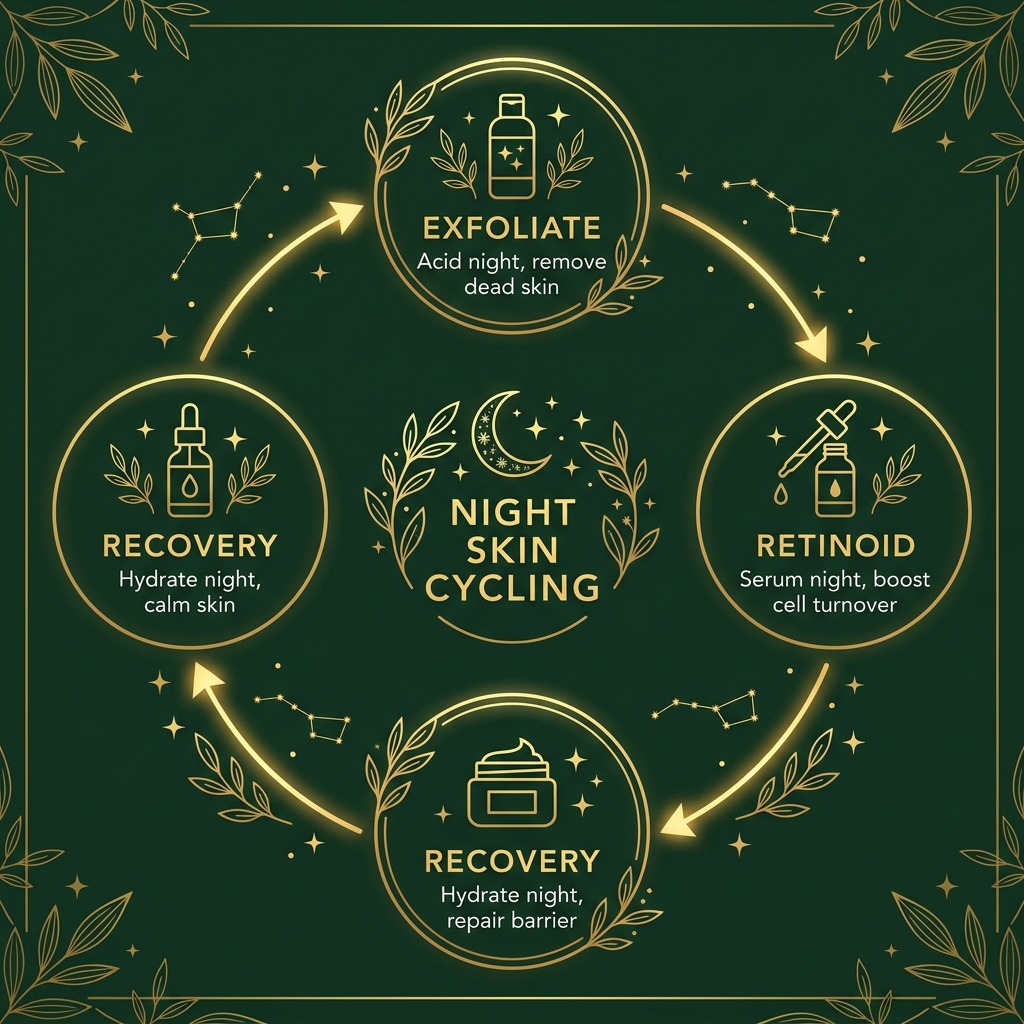
Skin cycling arrived as a viral concept and has since become one of the most recognizable routine frameworks in skincare. The premise is appealing: rotate your active ingredients across a four-night cycle, build in deliberate recovery nights, and get results without the irritation that derails so many routines.
Here is the honest assessment upfront: the method is genuinely sound, but it is not new.
Skincare experts have advised alternating actives and building in recovery for decades. What skin cycling contributed was a memorable name, a clear structure, and a framework simple enough that people actually follow it — which is not a trivial contribution, because adherence is where most routines fail.
This guide covers how it works, why it works, who it suits, and how to adapt it rather than following it rigidly.
Key Takeaway
Skin cycling is fundamentally a structured introduction method — its main value is teaching people not to use multiple actives every night. If your skin is already well-adjusted to actives, a simpler nightly routine may be equally effective.
What Skin Cycling Actually Is
The standard version is a four-night rotation.
| Night | Focus | What you apply |
|---|---|---|
| 1 | Exfoliation | Cleanser → chemical exfoliant → moisturizer |
| 2 | Retinoid | Cleanser → retinoid → moisturizer |
| 3 | Recovery | Cleanser → hydrating serum → moisturizer |
| 4 | Recovery | Cleanser → hydrating serum → moisturizer |
Then the cycle repeats.
Mornings stay the same throughout: gentle cleanser, any morning treatment you use, moisturizer, sunscreen.
That is the entire method. Its simplicity is the point.
What to do
- Follow the 4-night structure: Night 1 exfoliation, Night 2 retinoid, Nights 3-4 recovery.
- Use it to introduce new actives: The built-in recovery nights make new ingredients far less irritating.
- Adapt based on your skin: If skin is resilient, you can condense to a 3-night cycle.
What to avoid
- Stacking actives on active nights: Skin cycling only works if you keep each night simple.
- Skipping the recovery nights: Two recovery nights are not optional — they are what prevents irritation.
- Following it rigidly when skin is ready to progress: Skin cycling is a tool, not a permanent protocol.
Why It Works
The reasoning holds up well when you look at what actually goes wrong in most routines.
It prevents the over-exfoliation cycle
The most common way people damage their skin is using multiple actives too frequently. An exfoliating toner every morning, a retinoid every night, a weekly peel, plus a salicylic acid cleanser — none of these seems excessive individually, and together they compromise the barrier.
A damaged barrier produces exactly the problems people are trying to fix: roughness, redness, breakouts, and sensitivity. Then they add more products to address those, and the cycle deepens.
Skin cycling makes over-exfoliation structurally difficult. You cannot accidentally exfoliate five nights a week within the framework.
It builds recovery into the schedule
Actives work by prompting change — accelerated turnover, increased collagen synthesis, altered keratinization. Skin needs time to complete those processes and repair the barrier disruption they cause.
Recovery nights are not wasted nights. They are when the barrier rebuilds, which is what allows the active nights to be effective rather than merely irritating.
It removes decision-making
This sounds minor and is not. A routine requiring you to assess your skin each evening and choose accordingly is a routine you will eventually stop following.
A fixed schedule means no decisions. Night one is exfoliation. Night two is retinoid. There is nothing to work out.
Adherence is the single largest determinant of skincare outcomes, and anything that improves it produces real results — regardless of whether the underlying method is novel.
It suits how actives actually behave
Retinoids and exfoliating acids both cause irritation when combined in the same routine, and both need consistency to work. Alternating them resolves that tension: you get consistent exposure to each without stacking their irritation.
What It Gets Right and Where It Is Oversold
Being fair about both matters.
What it gets right
- Separating retinoids and exfoliants is genuinely good practice
- Building in recovery prevents the most common cause of routine failure
- Simplicity improves adherence more than sophistication does
- It gives beginners a structure that is difficult to get badly wrong
- It reframes “doing less” as strategic rather than lazy, which helps people who feel they should always be doing more
Where it is oversold
It is not a new discovery. Alternating actives and allowing recovery has been standard skincare advice for a long time. The framework is a packaging improvement, not a scientific one.
Four nights is arbitrary. There is nothing biologically significant about a four-day cycle. It is a convenient round number, not a finding.
It is not optimal for everyone. Some people need more exfoliation, some need less, some tolerate a retinoid nightly and get better results that way.
It will not fix a fundamentally wrong routine. If your products are unsuitable for your skin, rotating them changes little.
It does not replace sunscreen. No evening routine does.
Who Skin Cycling Suits
Beginners starting with actives. This is the strongest case. It provides structure, prevents the classic beginner mistake of using everything at once, and builds tolerance gradually.
Anyone recovering from over-exfoliation. If your barrier is compromised from doing too much, this offers a way back that still includes actives.
Sensitive skin that wants results. The built-in recovery makes actives tolerable for skin that cannot handle nightly use.
Anyone whose routine has become complicated. If you own eight products and use them inconsistently, this is a way to simplify without abandoning what works.
People who struggle with consistency. A fixed schedule requiring no judgement is easier to maintain than a flexible one.
Who Does Not Need It
Anyone already tolerating a retinoid nightly. Nightly retinoid use, when tolerated, generally produces better results than four-nights-in-eight. Do not reduce frequency to follow a framework.
Anyone with a very simple routine that works. If cleanser, moisturizer, and sunscreen keep your skin comfortable, adding a cycling schedule solves a problem you do not have.
People treating active acne. Acne treatment often requires consistent daily application of specific actives. Cycling can reduce effectiveness here — this is a conversation for a skincare professional rather than a framework to apply.
Anyone with an expert-prescribed regimen. Follow their guidance, not a social media schedule.
Very dry or barrier-compromised skin currently. You may need more than two recovery nights, or a period with no actives at all before starting.
How to Adapt It
The standard four-night cycle is a starting point, not a rule. These are the common modifications.
If your skin is sensitive: extend the recovery
Night 1: Exfoliation Night 2: Recovery Night 3: Retinoid Night 4: Recovery Night 5: Recovery
A five-night cycle with recovery between each active is considerably gentler and often more sustainable for reactive skin.
If your skin is resilient: compress it
Night 1: Exfoliation Night 2: Retinoid Night 3: Recovery
A three-night cycle increases active exposure for skin that handles it comfortably.
If you are new to retinoids: start with fewer actives
Night 1: Retinoid Night 2: Recovery Night 3: Recovery Night 4: Recovery
Introduce exfoliation only after your skin has adjusted to the retinoid — typically after four to six weeks. Adding both simultaneously is how beginners end up abandoning both.
If pigmentation is your main concern
Azelaic acid or tranexamic acid are gentle enough for recovery nights, since they do not accelerate turnover the way retinoids and acids do.
Night 1: Exfoliation Night 2: Retinoid Night 3: Azelaic acid or tranexamic acid Night 4: Recovery
If you have acne
Night 1: Salicylic acid Night 2: Retinoid or adapalene Night 3: Azelaic acid Night 4: Recovery
But note the earlier caution — persistent acne often needs consistent daily treatment rather than rotation, and that is worth discussing with a skincare professional.
What to Use on Each Night
Exfoliation night
Choose one:
- Glycolic acid — strongest, best for resilient skin
- Lactic acid — gentler, also hydrating
- Mandelic acid — gentlest AHA, good for sensitive skin and deeper skin tones
- Salicylic acid — oil-soluble, best for congestion
- Polyhydroxy acids — very gentle, suitable for reactive skin
Do not layer multiple exfoliants. One per night is the point of the framework.
Retinoid night
Choose one:
- Retinol — start at 0.25% or lower
- Retinaldehyde — stronger than retinol
- Adapalene — over the counter in some markets, good for congestion
- Targeted retinoid — as directed
Apply to completely dry skin. Damp skin increases penetration and irritation.
Recovery nights
The goal is barrier support:
- Hydrating serum with hyaluronic acid or glycerin
- Niacinamide, which supports barrier function
- Moisturizer with ceramides, cholesterol, or fatty acids
- Optionally, an occlusive layer if your skin is dry
What not to use: acids, retinoids, scrubs, or anything described as resurfacing. Recovery nights are recovery nights.
Common Mistakes
1. Treating recovery nights as optional. They are the mechanism that makes the framework work. Skipping them turns it back into an ordinary over-exfoliating routine.
2. Using multiple exfoliants on exfoliation night. A salicylic cleanser plus a glycolic toner is two exfoliants, not one.
3. Reducing an already-tolerated retinoid. If you use a retinoid nightly without irritation, cycling represents a downgrade rather than an improvement.
4. Expecting faster results. Cycling reduces irritation; it does not accelerate outcomes. The timelines remain eight to twelve weeks minimum.
5. Adding actives to morning routines. Using a glycolic toner every morning defeats the purpose entirely.
6. Following it rigidly when skin objects. If your skin is irritated on a scheduled active night, take a recovery night instead. The framework serves your skin, not the other way round.
7. Forgetting sunscreen. The framework governs evenings. Mornings still require SPF, and exfoliation and retinoids both make this more important.
What Results to Expect
Weeks 1-2: Little visible change. If you are new to retinoids, possible mild adjustment.
Weeks 3-6: Texture typically improves. Skin often feels more comfortable than on a more aggressive routine.
Weeks 6-12: Tone evens out, congestion reduces, fine lines may soften.
Beyond 12 weeks: Continued gradual improvement.
The realistic framing: skin cycling produces the results those actives would produce anyway, with less irritation along the way. It is a delivery method rather than a performance upgrade.
Your First Month, Week by Week
If you are starting from a simple routine, here is a realistic way to build into cycling without triggering the irritation it is meant to prevent.
Week 1-2: Establish the base
Do not start cycling yet. Use a gentle cleanser, a moisturizer suited to your skin, and sunscreen every morning. Nothing else.
The point: you need a stable baseline before introducing actives. If your barrier is already compromised, adding a retinoid and an exfoliant will not go well regardless of scheduling.
Move on when: your skin feels comfortable, nothing stings, and there is no flaking or tightness.
Week 3-4: Introduce one active
Add a retinoid only — no exfoliation yet.
Night 1: Retinoid Nights 2-4: Recovery
This is a one-active cycle. It looks minimal, and that is intentional. Introducing two new actives simultaneously is the single most common reason people abandon skincare routines.
Expect: possible mild dryness or flaking. This is normal adjustment.
Week 5-6: Assess before adding
If the retinoid is comfortable at one night in four, increase to two nights in four before adding anything else.
Night 1: Retinoid Night 2: Recovery Night 3: Retinoid Night 4: Recovery
Do not add exfoliation if: you are still experiencing dryness, flaking, or sensitivity from the retinoid.
Week 7-8: Add exfoliation
Once the retinoid is well tolerated, introduce a chemical exfoliant on one night.
Night 1: Exfoliation Night 2: Retinoid Night 3: Recovery Night 4: Recovery
This is the standard cycle, reached gradually rather than started cold.
Beyond week 8
Adjust based on how your skin responds. Some people compress to a three-night cycle. Others extend recovery. Both are correct if they suit your skin.
A useful marker: if your skin feels comfortable on recovery nights and shows no lingering irritation on active nights, your cycle is working. If it feels perpetually slightly irritated, extend recovery.
Adapting for Different Skin Types
Oily and congestion-prone: salicylic acid on exfoliation night, since it is oil-soluble and works inside pores. Lightweight gel moisturizers on recovery nights — do not skip moisturizer because your skin is oily.
Dry: lactic acid rather than glycolic on exfoliation night, since it hydrates as it exfoliates. Richer creams on recovery nights, and consider an occlusive final layer.
Sensitive: mandelic acid or a PHA on exfoliation night. Extend to a five-night cycle with recovery between each active. Introduce actives more slowly than the schedule above suggests.
Combination: apply actives across the whole face but vary the moisturizer — lighter through the T-zone, richer on drier areas.
Deeper skin tones: favour gentler exfoliants such as mandelic acid, since irritation carries a higher risk of post-inflammatory hyperpigmentation. The recovery nights are particularly valuable here.
Mature skin: cell turnover slows with age, so results take longer. Resist the temptation to compress the cycle in response — patience serves better than escalation.
Troubleshooting Your Cycle
“My skin is irritated on recovery nights too.” Your active nights are too strong. Reduce the exfoliant concentration, lower the retinoid strength, or extend to a five-night cycle. Persistent irritation across recovery nights means the barrier is not recovering, which defeats the purpose.
“I am not seeing any results after two months.” Check three things before changing the schedule. Are you using sunscreen daily? Are your concentrations high enough to be doing anything? Are you actually being consistent, or missing nights? Cycling does not compensate for gaps in any of those.
“I break out after exfoliation night.” This may be purging if you started recently and the breakouts are in your usual areas. If it persists past six weeks or appears in new locations, the exfoliant may be too strong or unsuitable.
“My skin feels great but nothing is changing.” Comfortable skin with no progress usually means your actives are too gentle or too infrequent. Consider compressing to a three-night cycle or increasing concentration gradually.
“I keep forgetting which night I am on.” Anchor the cycle to fixed days rather than counting. For example: Monday exfoliation, Tuesday retinoid, Wednesday and Thursday recovery, then repeat Friday. A fixed weekly pattern is easier to maintain than a rolling four-day count.
“Can I skip a night if I am too tired?” Yes. Skip an active night and treat it as a recovery night. Do not skip the recovery nights and double up on actives later — that reverses the entire logic of the framework.
Frequently Asked Questions
What is skin cycling? A four-night rotation: exfoliation, retinoid, then two recovery nights. It separates actives to reduce irritation and builds in barrier repair time.
Does skin cycling actually work? The underlying principle — alternating actives with recovery — is sound and long-established. The framework itself works mainly by improving consistency and preventing over-exfoliation.
Is skin cycling better than using a retinoid every night? Not if you tolerate nightly use. Nightly retinoid application, when your skin handles it, generally produces better results. Cycling is valuable for those who cannot tolerate that frequency.
Can I skin cycle in the morning? The framework is designed for evenings. Mornings should stay consistent: cleanser, any morning treatment, moisturizer, sunscreen.
How long before I see results from skin cycling? The same as the actives themselves — eight to twelve weeks. Cycling does not accelerate results.
Can I use vitamin C while skin cycling? Yes, in the morning. It sits outside the evening cycle entirely and does not conflict.
What if I break out during skin cycling? If you are using a retinoid or exfoliant, early breakouts may be purging, which typically resolves within four to six weeks. If breakouts appear in new areas or persist beyond eight weeks, reassess your products rather than the schedule.
Can I skin cycle with prescription tretinoin? Discuss it with your prescriber. Some regimens are designed for consistent nightly use, and reducing frequency independently may compromise results.
Do I need special products for skin cycling? No. Products marketed for skin cycling are a marketing response rather than a requirement. Any suitable exfoliant, retinoid, and moisturizer works.
Can I cycle if I only use one active? Yes, and this is often a good approach for beginners. Alternate the single active with recovery nights and build frequency as tolerance develops.
The Bottom Line
Skin cycling is a well-constructed framework built on sound principles that were not new when it went viral. That does not diminish its value — the framing genuinely helps people avoid the most common routine mistakes.
Its real contributions:
- It makes over-exfoliation structurally difficult
- It legitimizes recovery nights, which people otherwise skip
- It removes nightly decision-making, which improves adherence
- It gives beginners a structure that is hard to get badly wrong
What to keep in perspective:
- It is a scheduling method, not a new mechanism
- The four-night structure is arbitrary and should be adapted to your skin
- If you already tolerate a retinoid nightly, it is a step backwards
- No evening framework replaces daily sunscreen
Who should try it: anyone new to actives, anyone recovering from over-exfoliation, anyone with sensitive skin who wants results, and anyone whose routine has become too complicated to follow consistently.
Who should not bother: anyone whose current routine works, anyone tolerating nightly retinoid use, and anyone following an expert-prescribed regimen.
And the principle worth taking even if you never follow the schedule: most skin problems come from doing too much, too often. Recovery is not a gap between the parts of your routine that work. It is one of the parts that works.
Was this article helpful?

Anam Ahsan
Skincare Enthusiast & BloggerHi, I'm Anam! I'm a beauty and skincare enthusiast who loves testing new products and sharing honest, personal reviews. I document my skincare journey and share what works for my skin so you can make better choices for your routine.



Comments (24)
Hannah W.
2 days agoThis guide saved me so much money — went with the budget pick and honestly can't tell the difference from serums twice the price!
Anam Ahsan Author
1 day agoSo glad it worked out for you, Hannah! That's exactly the kind of result we hoped readers would see.