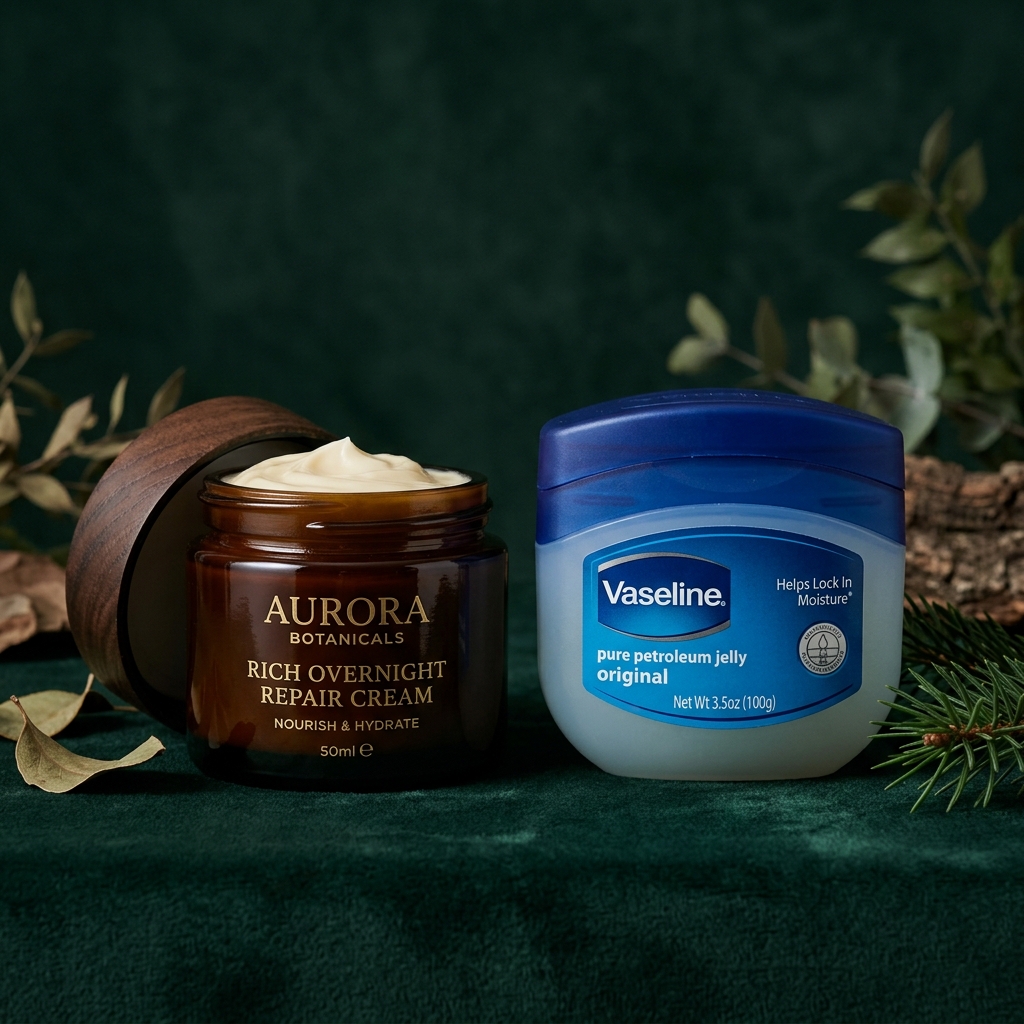
Slugging went from a niche K-beauty practice to a mainstream trend, and the results people report range from transformative to disastrous. That spread is not random — it reflects a technique that genuinely works for a specific type of skin and specific circumstances, and works badly outside them.
The underlying science is solid. Occlusives reduce water loss more effectively than anything else in skincare, and petrolatum in particular is exceptionally good at it.
The problem is application. Slugging is frequently recommended universally, applied over the wrong products, or used by people whose skin was never going to respond well.
This guide covers how it actually works, who genuinely benefits, the mistakes that cause the breakouts people report, and what to do instead if it does not suit you.
Key Takeaway
Petroleum jelly is the most effective occlusive ingredient on earth. Slugging essentially creates a greenhouse for your skin, trapping 99% of moisture from escaping and allowing a damaged barrier to repair overnight.
What Slugging Actually Is
Slugging means applying a layer of an occlusive product — most commonly petroleum jelly — as the final step of an evening routine, and leaving it on overnight.
The name comes from the appearance: a shiny, slightly slick surface.
The purpose is not moisturizing in the conventional sense. Petrolatum contains no water, no humectants, and no active ingredients. It does one thing: it forms a barrier that dramatically reduces water evaporation from the skin.
The Science Behind It
Transepidermal water loss
Your skin continuously loses water to the environment through the stratum corneum. This process is called transepidermal water loss, and it is a measurable indicator of barrier function.
When the barrier is intact, water loss is controlled. When it is compromised — through over-exfoliation, harsh cleansers, cold dry air, or conditions like eczema — water loss accelerates, and skin becomes dehydrated regardless of how much moisturizer you apply.
Why petrolatum is unusually effective
Petrolatum reduces transepidermal water loss more effectively than essentially any other topical ingredient, with research indicating reductions in the region of 98%. No plant oil, silicone, or butter comes close.
It is also inert. Petrolatum does not react with skin, does not oxidize, has no fragrance, and is one of the least allergenic substances used topically. It is frequently the recommended option for severely compromised or post-procedure skin for exactly this reason.
What it does and does not do
It does: create conditions where the skin can repair itself, by holding in the moisture already present.
It does not: add moisture, deliver actives, treat any condition directly, or “feed” the skin.
The useful mental model: slugging is a lid. Whether it helps depends entirely on what is underneath it.
The Petrolatum Reputation Problem
Since this is the ingredient most people slug with, its reputation is worth addressing.
The common concerns: that it is derived from petroleum, that it suffocates skin, and that it contains contaminants.
What is accurate:
Cosmetic-grade petrolatum is highly refined and subject to purity standards in regulated markets. The contaminant concerns relate to unrefined industrial-grade petroleum products, which are a different material entirely.
Skin does not breathe. The stratum corneum is composed of dead keratinized cells. Oxygen for living skin cells arrives via blood supply, not from the air. “Suffocating” the skin is not a mechanism that exists.
It is non-comedogenic in standard testing. Petrolatum itself does not block pores. Breakouts attributed to slugging are more often caused by what is trapped underneath it — which is a real problem, just a different one.
A fair summary: cosmetic-grade petrolatum is among the safest, best-studied, and most effective occlusives available. Its poor reputation stems from confusion with industrial products and a mechanism that does not exist.
What to do
- Apply over damp skin and moisturizer: Trap that hydration in.
- Use for barrier repair: Excellent if you've over-exfoliated or are adjusting to retinoids.
- You only need a pea-sized amount: A thin layer is enough to seal the skin.
What to avoid
- Slugging over strong actives: Trapping retinoids or AHAs will supercharge their irritation.
- Slugging if you're prone to acne: The occlusive environment can trap oil and bacteria, leading to breakouts.
- Slugging if you sweat heavily at night: Can lead to heat rash or milia.
Who Genuinely Benefits
Dry skin. The clearest case. Dry skin lacks lipids and loses water readily, and an occlusive layer addresses that directly.
Compromised barriers. Over-exfoliated, over-treated, or generally reactive skin recovers faster when water loss is controlled.
Cold, dry climates. Low humidity and indoor heating dramatically accelerate water loss. This is when slugging earns its place, and many people find it useful only in winter.
Extremely dry, flaky skin. Occlusives are standard for managing very dry skin, and petrolatum is a top choice for this purpose.
After a flight. Cabin humidity is extremely low. This is one of the more practically useful applications.
Specific dry areas. Lips, around the nostrils during a cold, cracked hands, and dry patches — targeted use is frequently more sensible than full-face application.
Who Should Skip It
Acne-prone skin. Not because petrolatum clogs pores, but because trapping sebum, bacteria, and residue against the skin overnight can worsen congestion. The risk is real even if the mechanism is misunderstood.
Oily skin. Adding an occlusive layer to skin already producing plenty of sebum is unnecessary and frequently uncomfortable.
Fungal folliculitis. Occlusion creates warm, moist conditions that suit Malassezia. If you are prone to small uniform itchy bumps, slugging is likely to worsen them.
Anyone with active breakouts in the areas they would be slugging.
Hot, humid climates. Ambient humidity is already high, water loss is low, and an occlusive layer adds heaviness without addressing a problem.
Anyone whose skin is comfortable. Slugging solves a specific problem. If you do not have that problem, it is an unnecessary step.
The Mistakes That Cause Problems
Most negative slugging experiences trace to one of these.
1. Slugging over active ingredients
This is the most important one.
Occlusion dramatically increases the penetration of whatever is underneath it. This is a well-established principle — occlusive layers enhance the absorption of skincare products.
Applied to skincare, this means slugging over a retinoid or exfoliating acid substantially increases how much reaches your skin. The result is frequently significant irritation, peeling, and barrier damage that people then misattribute to the petrolatum.
Do not slug over:
- Retinoids of any strength
- Exfoliating acids
- Benzoyl peroxide
- Any active you are still adjusting to
A distinction worth making: the “sandwich method” for retinoids — moisturizer, retinoid, moisturizer — uses a regular moisturizer, not an occlusive seal. That is a different technique with a different purpose.
2. Slugging over unclean skin
Trapping the day’s sebum, sunscreen residue, pollution, and makeup against your skin for eight hours is a reliable route to congestion.
Cleanse thoroughly first, including a first cleanse if you wore sunscreen or makeup.
3. Slugging over dry skin with nothing underneath
Petrolatum seals in whatever is present. On dry skin with no hydration beneath it, you are sealing in dryness.
Apply a humectant and a moisturizer first. Hyaluronic acid or glycerin on damp skin, then a moisturizer, then the occlusive layer.
4. Using too much
A thin layer is sufficient. A thick coating is uncomfortable, transfers to bedding, and offers no additional benefit.
5. Doing it every night regardless
Slugging is a tool for specific circumstances, not a nightly requirement. Many people benefit from it two or three times weekly in winter and not at all in summer.
6. Ignoring what your skin is telling you
If you develop congestion, small bumps, or breakouts after starting, that is information. Reduce frequency, apply it only to dry areas, or stop.
How to Slug Properly
Step 1: Cleanse thoroughly. Double cleanse if you wore sunscreen or makeup.
Step 2: Apply a humectant to damp skin. Hyaluronic acid, glycerin, or a hydrating essence. This provides the moisture you will be sealing in.
Step 3: Apply your moisturizer. Ideally one containing ceramides or barrier-supporting lipids.
Step 4: Apply a thin layer of occlusive. Petroleum jelly is standard, but alternatives exist — see below.
Step 5: Protect your bedding. An old pillowcase is worth using. Petrolatum transfers.
Step 6: Cleanse in the morning. A gentle cleanser rather than a water rinse, since you are removing an occlusive layer.
Frequency: two to three times weekly is sufficient for most people who benefit. Nightly is reasonable for very dry skin in a dry climate.
Occlusive Options Compared
Petroleum jelly is the default, but not the only choice.
| Occlusive | Effectiveness | Texture | Fungal-acne safe | Notes |
|---|---|---|---|---|
| Petrolatum | Highest | Heavy, greasy | Yes | Inert, non-comedogenic in testing |
| Mineral oil | High | Lighter | Yes | Easier to apply, less heavy |
| Dimethicone | Moderate | Light, silky | Yes | Breathable feel, good for oily skin |
| Squalane | Moderate | Light | Yes | Emollient more than occlusive |
| Lanolin | High | Very heavy | Varies | Effective but a common allergen |
| Shea butter | Moderate | Rich | No | Can feed Malassezia |
| Plant oils | Low to moderate | Varies | No | Mostly emollient, less occlusive |
For oily or acne-prone skin wanting some occlusion: a dimethicone-based product provides a lighter seal without the heaviness of petrolatum.
For fungal-acne-prone skin: petrolatum, mineral oil, dimethicone, and squalane are the safe options. Shea butter and most plant oils are not.
A note on lanolin: it is highly effective and derived from wool. It is also a relatively common allergen, so patch test before facial use.
Slugging Alternatives
If full-face slugging does not suit you, several middle grounds exist.
Targeted slugging. Apply the occlusive only to genuinely dry areas — around the nose, cheeks, dry patches — while leaving oilier zones uncovered. This is frequently more sensible than the all-or-nothing approach.
A ceramide-rich cream instead. A well-formulated barrier cream provides substantial occlusion with a lighter feel and the addition of barrier-supporting lipids.
Dimethicone-based products. These seal effectively while feeling considerably lighter than petrolatum.
Overnight masks. Many are essentially occlusive layers with added humectants, offering a similar function in a more cosmetically pleasant format.
A humidifier. Addressing the ambient dryness directly reduces the need to seal against it. Genuinely effective in heated indoor environments and often overlooked.
Simply moisturizing more. For mild dryness, applying a good moisturizer twice daily may be entirely sufficient without any occlusive step.
Seasonal Use
Winter and dry conditions: this is when slugging is most useful. Low humidity and indoor heating accelerate water loss substantially.
Summer and humid conditions: most people should skip it. Water loss is lower, and an occlusive layer in heat is uncomfortable and more likely to contribute to congestion.
Air travel: cabin humidity is very low. A single application during a long flight is one of the more practical uses.
Treating it as seasonal rather than permanent is the approach that suits most people. Your skin’s needs change with the environment, and your routine reasonably should too.
Slugging Beyond the Face
Some of the most useful applications are not facial at all, and they carry considerably less risk.
Hands. Applying an occlusive layer before bed, optionally under cotton gloves, is genuinely effective for cracked, dry hands. This is one of the least controversial and most reliably useful applications.
Feet. Particularly heels. Combined with a urea-based cream underneath, an occlusive layer overnight under socks softens thickened skin considerably faster than either alone.
Lips. Petrolatum is one of the more effective lip treatments available, and lips have no sebaceous glands to congest. Applying it overnight is straightforward and works.
Elbows and knees. Areas with few oil glands and thick skin respond well.
Cuticles. A small amount overnight softens them noticeably.
Around the nose during a cold. Repeated tissue use damages this area quickly, and an occlusive layer prevents the cracking and soreness that follow.
Body dryness generally. Applying moisturizer to damp skin after showering and sealing with an occlusive is effective for dry legs and arms in winter.
The advantage of these applications: none of these areas are prone to acne, so the main risk of facial slugging does not apply.
Your First Week
If you want to try it, this sequence limits the chance of a bad outcome.
Night 1: Slug only a small dry area — one cheek, or the areas around your nose. Cleanse thoroughly first, hydrate, moisturize, then apply a thin occlusive layer to that area only.
Morning 1: Cleanse properly with a gentle cleanser. Note how the treated area feels compared to the untreated area.
Nights 2-3: If the treated area feels better and shows no congestion, extend to a larger area.
Days 4-7: Watch specifically for small bumps or congestion appearing in treated areas. If they do, reduce to targeted application on dry patches only.
After one week: If your skin has responded well, settle into a frequency that suits — typically two to three times weekly in dry conditions.
If congestion appeared: stop full-face application. You may still benefit from targeted use on genuinely dry areas, or from a lighter dimethicone-based alternative.
Why start small: a full-face application on skin that does not suit it produces a week of congestion. A single-cheek test produces information at a fraction of the cost.
Where the Practice Came From
A brief note on origins, because it clarifies what slugging was originally for.
The technique predates the name considerably. Occlusive layers have been used in skincare for decades — petrolatum for targeted dry skin and barrier protection are established practices.
The K-beauty connection brought it into cosmetic routines, where it was used primarily in cold, dry climates as a final sealing step during winter months.
The social media version stripped away most of the context. What arrived in mainstream skincare discussion was “put petroleum jelly on your face” without the surrounding detail about who it suited, when, and over what.
Why this matters: the practical applications were always for dry, damaged, or compromised skin in conditions where water loss was the problem. Applied to oily, acne-prone skin in a humid climate, it is being used for something it was never intended to address.
The evidence base reflects this. Research on petrolatum and occlusion is substantial, but it concerns barrier repair and moisture retention — not general skin improvement for everyone. Extrapolating from “petrolatum reduces water loss by 98%” to “everyone should slug nightly” is a leap the research does not support.
A reasonable conclusion: treat slugging as what it originally was — a targeted intervention for dry or compromised skin, particularly in dry conditions — rather than a universal upgrade to a routine.
Frequently Asked Questions
What is slugging? Applying a layer of occlusive product — usually petroleum jelly — as the final evening step to reduce overnight water loss from the skin.
Does slugging cause breakouts? Petrolatum itself is non-comedogenic in standard testing. Breakouts usually result from trapping sebum, residue, or products against the skin, or from slugging on skin that was already congestion-prone.
Can I slug with retinol? No. Occlusion substantially increases penetration, which frequently causes significant irritation. Apply retinoids on their own or use the sandwich method with a regular moisturizer instead.
Is petroleum jelly bad for skin? Cosmetic-grade petrolatum is highly refined, inert, and one of the safest and best-studied occlusives available. Concerns about contaminants relate to unrefined industrial products.
Does slugging suffocate the skin? No. The outer layer of skin consists of dead cells and does not require oxygen from the air. Living skin cells receive oxygen through blood supply.
How often should I slug? Two to three times weekly is sufficient for most people who benefit. Nightly is reasonable for very dry skin in dry conditions. Skip it in humid weather.
Can oily skin slug? It is usually unnecessary and often uncomfortable. If you want some occlusion, a dimethicone-based product is a lighter alternative.
What can I use instead of petroleum jelly? Mineral oil, dimethicone-based creams, or ceramide-rich barrier creams. For fungal-acne-prone skin, avoid shea butter and most plant oils.
Should I slug over sunscreen? No. Slugging is an evening practice. Sunscreen should be removed as part of your evening cleanse.
Does slugging help with fine lines? Only indirectly and temporarily. Well-hydrated skin looks plumper, which softens the appearance of fine lines. It does not affect the underlying structure.
The Bottom Line
Slugging works, for the right skin, in the right circumstances, applied correctly. Outside those conditions it ranges from unnecessary to actively counterproductive.
It genuinely helps if you have:
- Dry skin, or a compromised barrier
- Cold, dry weather or heated indoor air
- Extremely dry, flaky skin
- Recently over-exfoliated or over-treated your skin
It is likely to cause problems if you have:
- Acne-prone or congestion-prone skin
- Fungal folliculitis
- Oily skin in a humid climate
- Active breakouts in the area
The rules that prevent most bad outcomes:
- Never slug over retinoids or acids — occlusion increases penetration significantly
- Cleanse thoroughly first — you are sealing in whatever is on your skin
- Hydrate underneath — an occlusive on dry skin seals in dryness
- Use a thin layer — more offers no additional benefit
- Treat it as seasonal and occasional rather than a nightly requirement
And the framing that makes it make sense: slugging is a lid, not a treatment. It holds in whatever is beneath it and does nothing on its own. If your skin is dry and you have hydrated it properly, that lid is useful. If your skin is oily, congested, or you have just applied a retinoid, it is the last thing you want.
Related reading:
- Face Oils: Do You Actually Need One?
- How to Layer Skincare With Hyaluronic Acid Correctly
- Why Does My Face Sting After Applying Skincare?
- Beta-Glucan: The Barrier Ingredient You Probably Haven’t Heard Of
- Body Acne: Why It Happens and How to Actually Treat It
Was this article helpful?

Anam Ahsan
Skincare Enthusiast & BloggerHi, I'm Anam! I'm a beauty and skincare enthusiast who loves testing new products and sharing honest, personal reviews. I document my skincare journey and share what works for my skin so you can make better choices for your routine.



Comments (24)
Hannah W.
2 days agoThis guide saved me so much money — went with the budget pick and honestly can't tell the difference from serums twice the price!
Anam Ahsan Author
1 day agoSo glad it worked out for you, Hannah! That's exactly the kind of result we hoped readers would see.